Ch 26: Direct-Current Circuits
Young & Freedman Calc - University Physics 14th Edition
Young & Freedman Calc14th EditionUniversity PhysicsISBN: 9780321973610당신이 사용하는 게 아니라요?교과서 변경
26장, 문제 23a

In the circuit shown in Fig. E26.23, ammeter A1 reads 10.0 A and the batteries have no appreciable internal resistance. What is the resistance of R?

검증된 단계별 안내
1
First, identify the components in the circuit. You have an ammeter A1 reading 10.0 A, a resistor R, and batteries with no internal resistance. This means the voltage across the batteries is fully applied to the circuit.
Use Ohm's Law, which states that \( V = I \times R \), where \( V \) is the voltage, \( I \) is the current, and \( R \) is the resistance. Since the ammeter reads 10.0 A, this is the current \( I \) flowing through the resistor R.
Determine the total voltage \( V \) supplied by the batteries. If the problem provides the voltage value, use it directly. If not, you may need additional information from the circuit diagram or problem context.
Substitute the known values into Ohm's Law to solve for the resistance \( R \). Rearrange the formula to \( R = \frac{V}{I} \). Plug in the current \( I = 10.0 \) A and the voltage \( V \) to find \( R \).
Verify your solution by checking the units and ensuring that the calculated resistance makes sense in the context of the circuit. If additional components or information are provided, consider their impact on the circuit and the resistance calculation.

비슷한 문제에 대한 검증된 영상 답변:

이 영상 해법은 위 문제에 도움이 된다고 튜터들이 추천한 것입니다.
도움이 되었나요?

주요 개념

질문에 올바르게 답하기 위해 반드시 이해해야 하는 핵심 개념들은 다음과 같습니다.

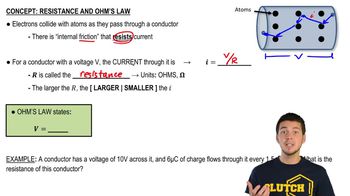
Ohm's Law

Ohm's Law is a fundamental principle in electronics that states the relationship between voltage, current, and resistance in a circuit: V = IR, where V is voltage, I is current, and R is resistance. This law is essential for calculating the resistance in a circuit when the current and voltage are known.
추천 영상:
03:07
Resistance and Ohm's Law

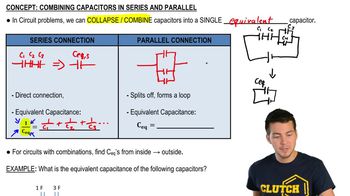
Series and Parallel Circuits

Understanding series and parallel circuits is crucial for analyzing how components like resistors affect the overall circuit. In a series circuit, resistances add up, while in a parallel circuit, the reciprocal of the total resistance is the sum of the reciprocals of individual resistances. This concept helps determine how the current flows and how resistances are calculated.
추천 영상:
09:51
Combining Capacitors in Series & Parallel

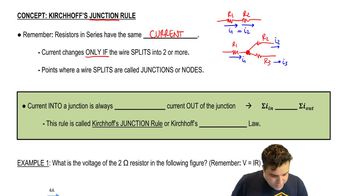
Kirchhoff's Circuit Laws

Kirchhoff's Circuit Laws include the Current Law (KCL) and the Voltage Law (KVL). KCL states that the total current entering a junction equals the total current leaving, while KVL states that the sum of the electrical potential differences around any closed network is zero. These laws are vital for analyzing complex circuits and determining unknown values like resistance.
추천 영상:
04:08
Kirchhoff's Junction Rule