Ch 26: Direct-Current Circuits
Young & Freedman Calc - University Physics 14th Edition
Young & Freedman Calc14th EditionUniversity PhysicsISBN: 9780321973610당신이 사용하는 게 아니라요?교과서 변경
26장, 문제 21g

Light Bulbs in Series and in Parallel. Two light bulbs have constant resistances of 400Ω and 800Ω. The two light bulbs are connected in series across a 120 V line. Afterwards, the two light bulbs are connected in parallel across the 120 V line. In each situation, which of the two bulbs glows the brightest?

검증된 단계별 안내
1
Understand the concept of brightness in light bulbs: Brightness is related to the power consumed by the bulb, which can be calculated using the formula \( P = \frac{V^2}{R} \) for series and parallel circuits.
Calculate the equivalent resistance for the bulbs in series: When resistors are in series, the total resistance \( R_{total} \) is the sum of individual resistances. So, \( R_{total} = R_1 + R_2 = 400\,\Omega + 800\,\Omega = 1200\,\Omega \).
Determine the current through the bulbs in series: Use Ohm's Law \( I = \frac{V}{R_{total}} \) to find the current. With \( V = 120\,V \) and \( R_{total} = 1200\,\Omega \), calculate \( I \). Then, use \( P = I^2 \times R \) to find the power for each bulb.
Calculate the equivalent resistance for the bulbs in parallel: For parallel circuits, the reciprocal of the total resistance is the sum of the reciprocals of individual resistances. \( \frac{1}{R_{total}} = \frac{1}{R_1} + \frac{1}{R_2} \). Solve for \( R_{total} \).
Determine the power for each bulb in parallel: Since the voltage across each bulb is the same (120 V), use \( P = \frac{V^2}{R} \) for each bulb to find the power. Compare the power values to determine which bulb glows the brightest in parallel.

비슷한 문제에 대한 검증된 영상 답변:

이 영상 해법은 위 문제에 도움이 된다고 튜터들이 추천한 것입니다.
영상 길이:
4m
도움이 되었나요?

주요 개념

질문에 올바르게 답하기 위해 반드시 이해해야 하는 핵심 개념들은 다음과 같습니다.

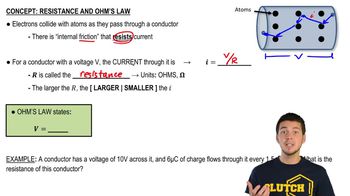
Ohm's Law

Ohm's Law states that the current through a conductor between two points is directly proportional to the voltage across the two points, represented by the formula V = IR, where V is voltage, I is current, and R is resistance. This principle helps determine the current flowing through each bulb in both series and parallel configurations.
추천 영상:
가이드 코스
03:07
Resistance and Ohm's Law

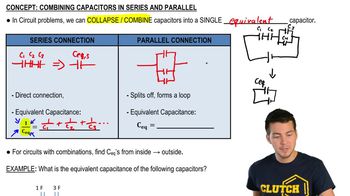
Series and Parallel Circuits

In a series circuit, components are connected end-to-end, so the same current flows through each component, but the voltage is divided among them. In a parallel circuit, components are connected across the same voltage source, so each component receives the full voltage, but the current is divided based on resistance. Understanding these configurations is crucial for analyzing the brightness of the bulbs.
추천 영상:
가이드 코스
09:51
Combining Capacitors in Series & Parallel

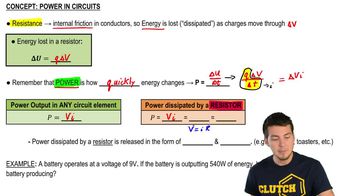
Power Dissipation in Resistors

Power dissipation in a resistor is given by the formula P = IV, where P is power, I is current, and V is voltage. Alternatively, it can be expressed as P = I²R or P = V²/R. The brightness of a bulb is related to the power it dissipates, so calculating power for each bulb in both series and parallel setups helps determine which bulb glows brightest.
추천 영상:
가이드 코스
06:18
Power in Circuits