
Ch 30: Inductance
Young & Freedman Calc - University Physics 14th Edition
Young & Freedman Calc14th EditionUniversity PhysicsISBN: 9780321973610당신이 사용하는 게 아니라요?교과서 변경
30장, 문제 15b

Inductance of a Solenoid. A metallic laboratory spring is typically 5.00 cm long and 0.150 cm in diameter and has 50 coils. If you connect such a spring in an electric circuit, how much self-inductance must you include for it if you model it as an ideal solenoid?

검증된 단계별 안내
1
Understand the formula for the inductance of a solenoid: \( L = \frac{\mu_0 N^2 A}{l} \), where \( L \) is the inductance, \( \mu_0 \) is the permeability of free space, \( N \) is the number of turns, \( A \) is the cross-sectional area, and \( l \) is the length of the solenoid.
Calculate the cross-sectional area \( A \) of the solenoid using the formula for the area of a circle: \( A = \pi r^2 \). The radius \( r \) is half of the diameter, so \( r = \frac{0.150 \text{ cm}}{2} \). Convert the radius to meters before calculating the area.
Convert the length of the solenoid from centimeters to meters. The length \( l \) is given as 5.00 cm, which is equivalent to 0.050 meters.
Substitute the values into the inductance formula. Use \( \mu_0 = 4\pi \times 10^{-7} \text{ T m/A} \) for the permeability of free space, \( N = 50 \) for the number of coils, and the calculated values for \( A \) and \( l \).
Simplify the expression to find the self-inductance \( L \) of the solenoid. Ensure all units are consistent, and perform the necessary arithmetic operations to complete the calculation.

비슷한 문제에 대한 검증된 영상 답변:

이 영상 해법은 위 문제에 도움이 된다고 튜터들이 추천한 것입니다.
영상 길이:
1m
도움이 되었나요?

주요 개념

질문에 올바르게 답하기 위해 반드시 이해해야 하는 핵심 개념들은 다음과 같습니다.

Inductance

Inductance is a property of an electrical conductor that quantifies its ability to induce an electromotive force (EMF) when the current flowing through it changes. It is measured in henries (H) and is crucial for understanding how solenoids and other inductive components behave in circuits, affecting energy storage and transfer.
추천 영상:
가이드 코스
12:59
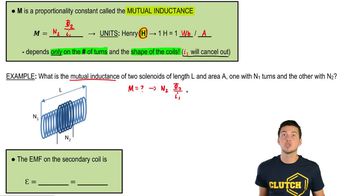
Mutual Induction

Solenoid

A solenoid is a coil of wire designed to create a magnetic field when an electric current passes through it. The inductance of a solenoid depends on its physical characteristics, such as the number of turns, length, and cross-sectional area, as well as the permeability of the core material. Solenoids are used in various applications, including electromagnets and inductors.
추천 영상:
가이드 코스
11:47
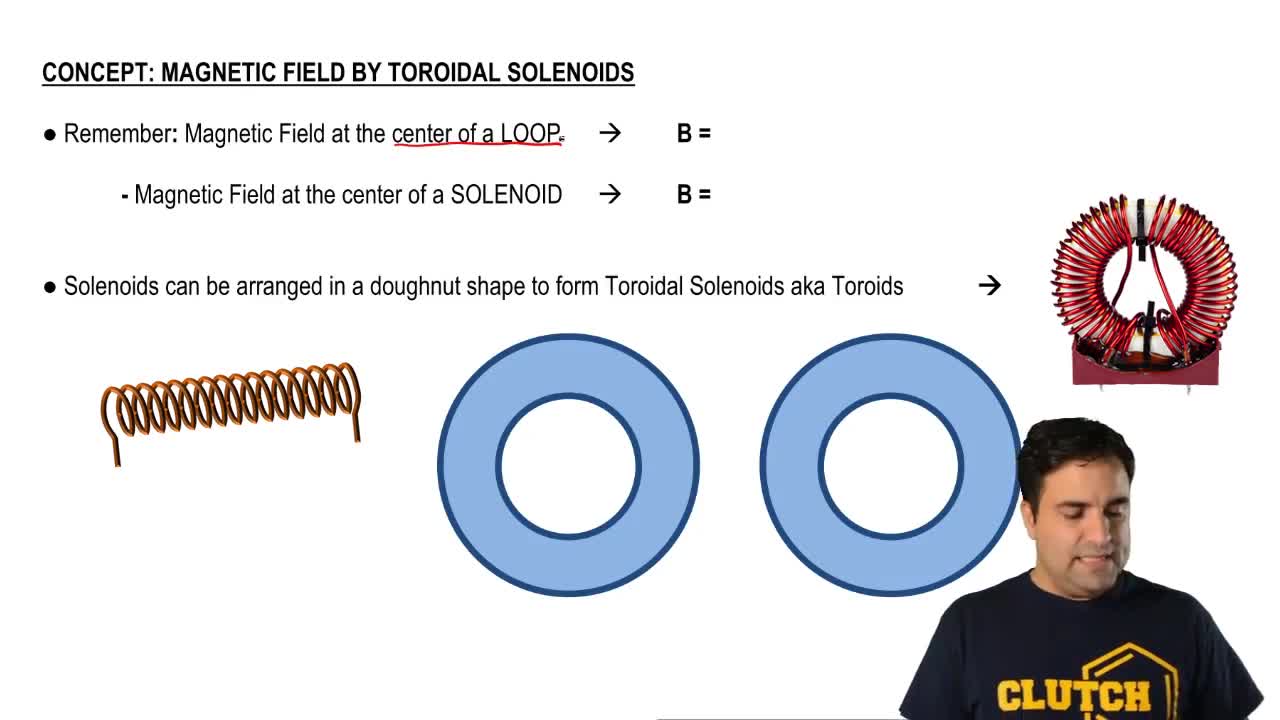
Toroidal Solenoids aka Toroids

Self-Inductance Formula for Solenoids

The self-inductance of a solenoid can be calculated using the formula L = (μ₀ * N² * A) / l, where L is the inductance, μ₀ is the permeability of free space, N is the number of turns, A is the cross-sectional area, and l is the length of the solenoid. This formula helps determine how the solenoid will behave in an electrical circuit, particularly in terms of energy storage and magnetic field generation.
추천 영상:
가이드 코스
07:58
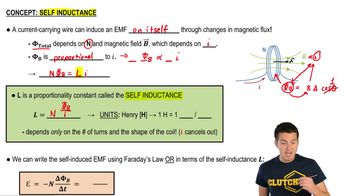
Self Inductance