Ch 30: Inductance
Young & Freedman Calc - University Physics 14th Edition
Young & Freedman Calc14th EditionUniversity PhysicsISBN: 9780321973610당신이 사용하는 게 아니라요?교과서 변경
30장, 문제 12a

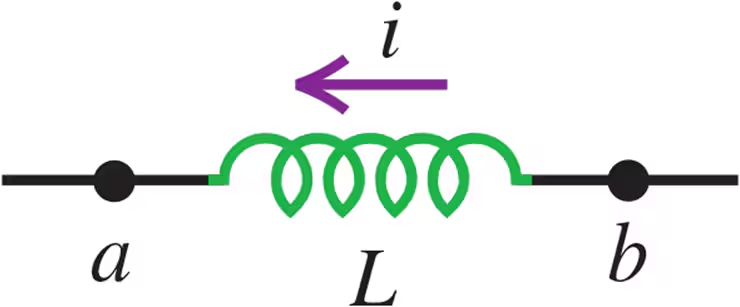
The inductor shown in Fig. E30.11 has inductance 0.260 H and carries a current in the direction shown. The current is changing at a constant rate. The potential between points a and b is Vab = 1.04 V, with point a at higher potential. Is the current increasing or decreasing?

검증된 단계별 안내
1
Identify the given values: The inductance of the inductor is 0.260 H, and the potential difference between points a and b is Vab = 1.04 V, with point a at a higher potential.
Recall the formula for the potential difference across an inductor: V = L * (di/dt), where V is the potential difference, L is the inductance, and di/dt is the rate of change of current.
Since point a is at a higher potential than point b, the potential difference Vab is positive. This indicates that the induced emf opposes the change in current according to Lenz's Law.
Determine the direction of the current change: If the current were increasing, the induced emf would oppose the increase, making point b higher in potential than point a. Since point a is higher, the current must be decreasing.
Conclude that the current is decreasing because the positive potential difference indicates that the induced emf is acting to oppose a decrease in current.

비슷한 문제에 대한 검증된 영상 답변:

이 영상 해법은 위 문제에 도움이 된다고 튜터들이 추천한 것입니다.
영상 길이:
1m
도움이 되었나요?

주요 개념

질문에 올바르게 답하기 위해 반드시 이해해야 하는 핵심 개념들은 다음과 같습니다.

Inductance

Inductance is a property of an electrical conductor, typically a coil, that quantifies its ability to oppose changes in current. It is measured in henries (H) and is determined by the coil's geometry and the number of turns. An inductor stores energy in a magnetic field when current flows through it, and this energy opposes changes in the current.
추천 영상:
가이드 코스
12:59
Mutual Induction

Electromotive Force (EMF) in Inductors

The electromotive force (EMF) induced in an inductor is due to the change in current flowing through it. According to Faraday's Law, the EMF is proportional to the rate of change of current and the inductance. The direction of the induced EMF opposes the change in current, as described by Lenz's Law, which is why point a is at a higher potential when the current is decreasing.
추천 영상:

Potential Difference

Potential difference, or voltage, between two points in a circuit is the work needed to move a charge between those points. In the context of an inductor, the potential difference is influenced by the induced EMF due to changing current. If point a is at a higher potential than point b, it indicates that the EMF is opposing the current flow, suggesting the current is decreasing.
추천 영상:
가이드 코스
07:04
Potential Difference Between Two Charges
관련 실천
교과서 질문

At the instant when the current in an inductor is increasing at a rate of 0.0640 A/s, the magnitude of the self-induced emf is 0.0160 V. What is the inductance of the inductor?

2031
views

교과서 질문

At the instant when the current in an inductor is increasing at a rate of 0.0640 A/s, the magnitude of the self-induced emf is 0.0160 V. If the inductor is a solenoid with 400 turns, what is the average magnetic flux through each turn when the current is 0.720 A?

2143
views
교과서 질문

When the current in a toroidal solenoid is changing at a rate of 0.0260 A/s, the magnitude of the induced emf is 12.6 mV. When the current equals 1.40 A, the average flux through each turn of the solenoid is 0.00285 Wb. How many turns does the solenoid have?

2683
views
교과서 질문

A long, straight solenoid has 800 turns. When the current in the solenoid is 2.90 A, the average flux through each turn of the solenoid is 3.25 × 10⁻³ Wb. What must be the magnitude of the rate of change of the current in order for the self-induced emf to equal 6.20 mV?

2609
views
교과서 질문

Inductance of a Solenoid. A metallic laboratory spring is typically 5.00 cm long and 0.150 cm in diameter and has 50 coils. If you connect such a spring in an electric circuit, how much self-inductance must you include for it if you model it as an ideal solenoid?

2241
views
교과서 질문

A toroidal solenoid has mean radius 12.0 cm and crosssectional area 0.600 cm2. How many turns does the solenoid have if its inductance is 0.100 mH?

2189
views
1
rank