Ch 36: Diffraction
Young & Freedman Calc - University Physics 14th Edition
Young & Freedman Calc14th EditionUniversity PhysicsISBN: 9780321973610당신이 사용하는 게 아니라요?교과서 변경
36장, 문제 29

(a) What is the wavelength of light that is deviated in the first order through an angle of 13.5° by a transmission grating having 5000 slits/cm? (b) What is the second-order deviation of this wavelength? Assume normal incidence.

검증된 단계별 안내
1
Convert the grating's slit density into the slit spacing (d). The slit density is given as 5000 slits/cm. Use the formula: d=1N, where N is the number of slits per unit length. Ensure the units are consistent (convert cm to meters).
Use the diffraction grating equation to find the wavelength of light for the first-order deviation. The equation is: nλ=dsinθ, where n is the order of diffraction (n=1 for first order), λ is the wavelength, d is the slit spacing, and θ is the angle of deviation (13.5°). Rearrange the equation to solve for λ: λ=dnsinθ.
Substitute the known values into the equation from step 2. Use the slit spacing (d) calculated in step 1, n=1 for first order, and θ=13.5° (convert the angle to radians if necessary). This will give the wavelength λ in meters.
To find the second-order deviation for this wavelength, use the same diffraction grating equation: nλ=dsinθ. Here, n=2 for the second order, λ is the wavelength found in part (a), and d is the slit spacing. Rearrange the equation to solve for θ: θ=arcsinnλd.
Substitute the known values into the equation from step 4. Use n=2, the wavelength λ from part (a), and the slit spacing d. Calculate the angle θ for the second-order deviation. Ensure the angle is expressed in degrees if required.

비슷한 문제에 대한 검증된 영상 답변:

이 영상 해법은 위 문제에 도움이 된다고 튜터들이 추천한 것입니다.
영상 길이:
6m
도움이 되었나요?

주요 개념

질문에 올바르게 답하기 위해 반드시 이해해야 하는 핵심 개념들은 다음과 같습니다.

Diffraction Grating

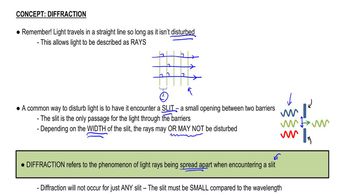
A diffraction grating is an optical component with a periodic structure that disperses light into its component wavelengths. It consists of multiple slits or grooves, which cause constructive and destructive interference of light waves. The angle at which light is deviated depends on the wavelength and the spacing of the slits, allowing for the analysis of light spectra.
추천 영상:

Order of Diffraction

The order of diffraction refers to the integer number that indicates the specific angle at which light is constructively interfered after passing through a grating. The first order corresponds to the first maximum of intensity observed, while higher orders (like second order) represent subsequent maxima. The angle of deviation increases with the order, affecting the wavelength calculation.
추천 영상:

Wavelength Calculation

Wavelength calculation in the context of diffraction involves using the grating equation, which relates the angle of diffraction, the wavelength of light, and the grating spacing. The equation is given by d sin(θ) = mλ, where d is the distance between slits, θ is the angle of deviation, m is the order of diffraction, and λ is the wavelength. This relationship allows for determining the wavelength based on the observed angle and grating parameters.
추천 영상:
가이드 코스
05:42
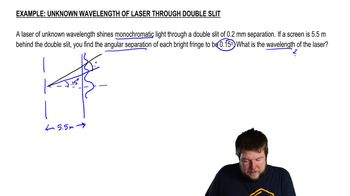
Unknown Wavelength of Laser through Double Slit
관련 실천
교과서 질문

The wavelength range of the visible spectrum is approximately 380–750 nm. White light falls at normal incidence on a diffraction grating that has 350 slits/mm. Find the angular width of the visible spectrum in the first order.

318
views

교과서 질문

If the planes of a crystal are 3.50 Å (1 Å = 10-10 m = 1 Ångstrom unit) apart, what wavelength of electromagnetic waves is needed so that the first strong interference maximum in the Bragg reflection occurs when the waves strike the planes at an angle of 22.0°, and in what part of the electromagnetic spectrum do these waves lie?

1729
views
교과서 질문

If a diffraction grating produces its third-order bright band at an angle of 78.4° for light of wavelength 681 nm, find (a) the number of slits per centimeter for the grating and (b) the angular location of the first-order and second-order bright bands. (c) Will there be a fourth-order bright band? Explain.

261
views
교과서 질문

Two satellites at an altitude of 1200 km are separated by 28 km. If they broadcast 3.6 cm microwaves, what minimum receiving-dish diameter is needed to resolve (by Rayleigh’s criterion) the two transmissions?

1507
views
교과서 질문

If a diffraction grating produces a third-order bright spot for red light (of wavelength 700 nm) at 65.0° from the central maximum, at what angle will the second-order bright spot be for violet light (of wavelength 400 nm)?

328
views
교과서 질문

A laser beam of wavelength λ = 632.8 nm shines at normal incidence on the reflective side of a compact disc. (a) The tracks of tiny pits in which information is coded onto the CD are 1.60 μm apart. For what angles of reflection (measured from the normal) will the intensity of light be maximum? (b) On a DVD, the tracks are only 0.740 μm apart. Repeat the calculation of part (a) for the DVD.

1453
views