Ch 36: Diffraction
Young & Freedman Calc - University Physics 14th Edition
Young & Freedman Calc14th EditionUniversity PhysicsISBN: 9780321973610당신이 사용하는 게 아니라요?교과서 변경
36장, 문제 34a

If the planes of a crystal are 3.50 Å (1 Å = 10-10 m = 1 Ångstrom unit) apart, what wavelength of electromagnetic waves is needed so that the first strong interference maximum in the Bragg reflection occurs when the waves strike the planes at an angle of 22.0°, and in what part of the electromagnetic spectrum do these waves lie?

검증된 단계별 안내
1
Step 1: Understand the problem. This is a Bragg diffraction problem, where we use Bragg's law to determine the wavelength of electromagnetic waves that produce constructive interference. Bragg's law is given by: nλ=2dsinθ, where n is the order of the diffraction (here, the first maximum means n=1), λ is the wavelength, d is the spacing between the planes, and θ is the angle of incidence.
Step 2: Write down the known values. The spacing between the planes is d=3.50Å (convert this to meters: d=3.50×10⁻¹⁰ m). The angle of incidence is θ=22.0°. The order of diffraction is n=1.
Step 3: Rearrange Bragg's law to solve for the wavelength λ. Substituting n=1, the equation becomes: λ=2dsinθ.
Step 4: Substitute the known values into the equation. Use d=3.50×10⁻¹⁰ m and θ=22.0°. Ensure that the angle is converted to radians before calculating the sine function: θ=22.0°×π/180 radians.
Step 5: Once the wavelength λ is calculated, determine the part of the electromagnetic spectrum it belongs to. Compare the wavelength to the ranges of the electromagnetic spectrum (e.g., X-rays, ultraviolet, visible light, etc.).

비슷한 문제에 대한 검증된 영상 답변:

이 영상 해법은 위 문제에 도움이 된다고 튜터들이 추천한 것입니다.
영상 길이:
4m
도움이 되었나요?

주요 개념

질문에 올바르게 답하기 위해 반드시 이해해야 하는 핵심 개념들은 다음과 같습니다.

Bragg's Law

Bragg's Law relates the wavelength of electromagnetic waves to the angle of incidence and the distance between crystal planes. It is expressed as nλ = 2d sin(θ), where n is the order of the maximum, λ is the wavelength, d is the distance between planes, and θ is the angle of incidence. This principle is fundamental in understanding how waves interact with crystal structures to produce interference patterns.
추천 영상:
10:20
Gauss' Law

Interference Patterns

Interference patterns arise when two or more waves overlap, leading to regions of constructive and destructive interference. In the context of Bragg reflection, constructive interference occurs when the path difference between waves reflected from adjacent planes is an integer multiple of the wavelength. This results in observable maxima, which are critical for determining the wavelength of the incident waves.
추천 영상:
03:47
Wave Interference & Superposition

Electromagnetic Spectrum

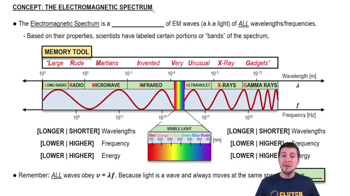
The electromagnetic spectrum encompasses all types of electromagnetic radiation, ranging from radio waves to gamma rays. Each type of radiation is characterized by its wavelength and frequency. In this problem, determining the wavelength of the waves that produce the first strong interference maximum will help identify where these waves fall within the spectrum, such as in the X-ray or visible light regions.
추천 영상:
06:06
The Electromagnetic Spectrum
관련 실천
교과서 질문

The wavelength range of the visible spectrum is approximately 380–750 nm. White light falls at normal incidence on a diffraction grating that has 350 slits/mm. Find the angular width of the visible spectrum in the first order.

318
views

교과서 질문

Two satellites at an altitude of 1200 km are separated by 28 km. If they broadcast 3.6 cm microwaves, what minimum receiving-dish diameter is needed to resolve (by Rayleigh’s criterion) the two transmissions?

1507
views
교과서 질문

If you can read the bottom row of your doctor’s eye chart, your eye has a resolving power of 1 arcminute, equal to 1/60 degree. If this resolving power is diffraction-limited, to what effective diameter of your eye’s optical system does this correspond? Use Rayleigh’s criterion and assume λ = 550 nm.

59
views
교과서 질문

The VLBA (Very Long Baseline Array) uses a number of individual radio telescopes to make one unit having an equivalent diameter of about 8000 km. When this radio telescope is focusing radio waves of wavelength 2.0 cm, what would have to be the diameter of the mirror of a visible-light telescope focusing light of wavelength 550 nm so that the visible-light telescope has the same resolution as the radio telescope?

48
views
교과서 질문

(a) What is the wavelength of light that is deviated in the first order through an angle of 13.5° by a transmission grating having 5000 slits/cm? (b) What is the second-order deviation of this wavelength? Assume normal incidence.

287
views
교과서 질문

A laser beam of wavelength λ = 632.8 nm shines at normal incidence on the reflective side of a compact disc. (a) The tracks of tiny pits in which information is coded onto the CD are 1.60 μm apart. For what angles of reflection (measured from the normal) will the intensity of light be maximum? (b) On a DVD, the tracks are only 0.740 μm apart. Repeat the calculation of part (a) for the DVD.

1453
views