Ch 35: Interference
Young & Freedman Calc - University Physics 14th Edition
Young & Freedman Calc14th EditionUniversity PhysicsISBN: 9780321973610당신이 사용하는 게 아니라요?교과서 변경
35장, 문제 27a

A uniform film of TiO2, 1036 nm thick and having index of refraction 2.62, is spread uniformly over the surface of crown glass of refractive index 1.52. Light of wavelength 520.0 nm falls at normal incidence onto the film from air. You want to increase the thickness of this film so that the reflected light cancels. What is the minimum thickness of TiO2 that you must add so the reflected light cancels as desired?

검증된 단계별 안내
1
Step 1: Understand the concept of thin-film interference. Reflected light cancels when destructive interference occurs. This happens when the optical path difference between the two reflected rays is an odd multiple of half the wavelength in the film.
Step 2: Calculate the wavelength of light inside the TiO2 film. The wavelength in the film is given by \( \lambda_{film} = \frac{\lambda_{air}}{n_{film}} \), where \( \lambda_{air} \) is the wavelength in air (520.0 nm) and \( n_{film} \) is the refractive index of TiO2 (2.62).
Step 3: Determine the condition for destructive interference. For destructive interference, the optical path difference must satisfy \( 2t = (m + \frac{1}{2}) \lambda_{film} \), where \( t \) is the thickness of the film, \( m \) is an integer (order of interference), and \( \lambda_{film} \) is the wavelength in the film.
Step 4: Calculate the additional thickness needed. The current thickness of the film is 1036 nm. To achieve destructive interference, find the minimum additional thickness \( \Delta t \) such that the total thickness \( t_{total} = t_{current} + \Delta t \) satisfies the interference condition.
Step 5: Solve for \( \Delta t \). Rearrange the interference equation to isolate \( \Delta t \), ensuring that the total thickness corresponds to the next odd multiple of half the wavelength in the film. Use \( \Delta t = \frac{(m + \frac{1}{2}) \lambda_{film}}{2} - t_{current} \) to find the minimum additional thickness.

비슷한 문제에 대한 검증된 영상 답변:

이 영상 해법은 위 문제에 도움이 된다고 튜터들이 추천한 것입니다.
도움이 되었나요?

주요 개념

질문에 올바르게 답하기 위해 반드시 이해해야 하는 핵심 개념들은 다음과 같습니다.

Interference of Light

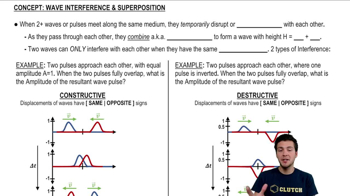
Interference occurs when two or more light waves overlap, resulting in a new wave pattern. In thin films, constructive or destructive interference can happen depending on the path difference between reflected waves. For destructive interference, the path difference must equal an odd multiple of half the wavelength, leading to cancellation of reflected light.
추천 영상:
가이드 코스
03:47
Wave Interference & Superposition

Refractive Index

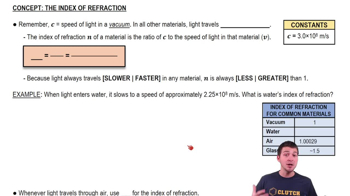
The refractive index is a dimensionless number that describes how light propagates through a medium. It is defined as the ratio of the speed of light in a vacuum to the speed of light in the medium. In this scenario, the refractive indices of TiO2 and crown glass are crucial for determining how light reflects and refracts at the boundaries, affecting the interference pattern.
추천 영상:
가이드 코스
03:46
Index of Refraction

Thin Film Thickness

The thickness of a thin film plays a critical role in determining the conditions for interference. For a film to cause destructive interference, its thickness must be adjusted so that the additional path length of light reflected from the top and bottom surfaces leads to a phase shift that results in cancellation. The minimum thickness can be calculated using the wavelength of light and the refractive indices involved.
추천 영상:
가이드 코스
07:58
Thin Lens Equation
관련 실천
교과서 질문
What is the thinnest soap film (excluding the case of zero thickness) that appears black when illuminated with light with wavelength 480 nm? The index of refraction of the film is 1.33, and there is air on both sides of the film.
327
views

교과서 질문

Two slits spaced 0.260 mm apart are 0.900 m from a screen and illuminated by coherent light of wavelength 660 nm. The intensity at the center of the central maximum (u = 0°) is I0. What is the distance on the screen from the center of the central maximum to the point where the intensity has fallen to I0/2?

1691
views
교과서 질문

Two rectangular pieces of plane glass are laid one upon the other on a table. A thin strip of paper is placed between them at one edge so that a very thin wedge of air is formed. The plates are illuminated at normal incidence by 546-nm light from a mercury-vapor lamp. Interference fringes are formed, with 15.0 fringes per centimeter. Find the angle of the wedge.

351
views
교과서 질문

How far must the mirror M2 (see Fig. 35.19) of the Michelson interferometer be moved so that 1800 fringes of He-Ne laser light (λ = 633 nm) move across a line in the field of view?

<Image>

339
views
교과서 질문

When viewing a piece of art that is behind glass, one often is affected by the light that is reflected off the front of the glass (called glare), which can make it difficult to see the art clearly. One solution is to coat the outer surface of the glass with a film to cancel part of the glare. If the glass has a refractive index of 1.62 and you use TiO2, which has an index of refraction of 2.62, as the coating, what is the minimum film thickness that will cancel light of wavelength 505 nm?

455
views
교과서 질문

What is the thinnest film of a coating with n = 1.42 on glass (n = 1.52) for which destructive interference of the red component (650 nm) of an incident white light beam in air can take place by reflection?

393
views