Ch 35: Interference
Young & Freedman Calc - University Physics 14th Edition
Young & Freedman Calc14th EditionUniversity PhysicsISBN: 9780321973610당신이 사용하는 게 아니라요?교과서 변경
35장, 문제 35

Two rectangular pieces of plane glass are laid one upon the other on a table. A thin strip of paper is placed between them at one edge so that a very thin wedge of air is formed. The plates are illuminated at normal incidence by 546-nm light from a mercury-vapor lamp. Interference fringes are formed, with 15.0 fringes per centimeter. Find the angle of the wedge.

검증된 단계별 안내
1
Step 1: Understand the problem. The interference fringes are formed due to the thin wedge of air between the glass plates. The number of fringes per unit length is related to the wavelength of the light and the angle of the wedge. We need to calculate the angle of the wedge using the given data.
Step 2: Recall the formula for fringe spacing in a wedge-shaped air film. The distance between adjacent fringes (Δx) is given by: Δx=λθ, where λ is the wavelength of the light and θ is the angle of the wedge.
Step 3: Use the relationship between fringe density and fringe spacing. Fringe density (number of fringes per unit length) is the reciprocal of fringe spacing: n=1Δx. Here, n = 15 fringes per centimeter, and Δx = 1/n.
Step 4: Substitute the value of Δx into the formula for fringe spacing. Rearrange the formula to solve for θ: θ=λΔx. Use λ = 546 nm (convert to meters: 546 × 10⁻⁹ m) and Δx = 1/n (convert n to fringes per meter: 15 × 100 fringes per meter).
Step 5: Perform the substitution and simplify the expression for θ. This will give the angle of the wedge in radians. If needed, convert the angle to degrees using the conversion factor: θ(degrees)=θ(radians)×180π.

비슷한 문제에 대한 검증된 영상 답변:

이 영상 해법은 위 문제에 도움이 된다고 튜터들이 추천한 것입니다.
도움이 되었나요?

주요 개념

질문에 올바르게 답하기 위해 반드시 이해해야 하는 핵심 개념들은 다음과 같습니다.

Interference of Light

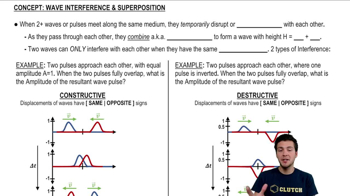
Interference occurs when two or more light waves overlap, resulting in a new wave pattern. This phenomenon can produce bright and dark fringes, known as interference fringes, due to constructive and destructive interference. In this scenario, the thin wedge of air between the glass plates causes varying path lengths for the light waves, leading to the observed fringes.
추천 영상:
가이드 코스
03:47
Wave Interference & Superposition

Wedge Formation

A wedge is a geometrical shape that tapers from one end to another, creating a varying thickness. In the context of this problem, the thin air wedge formed between the two glass plates leads to a gradient in the optical path length of the light. The angle of the wedge can be determined by analyzing the spacing of the interference fringes, which is directly related to the wedge's geometry.
추천 영상:
가이드 코스
06:55
Blocks on a Wedge

Fringe Spacing and Wavelength

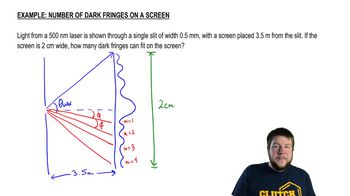
The spacing of the interference fringes is influenced by the wavelength of the light used and the angle of the wedge. The number of fringes per unit length can be related to the wavelength and the wedge angle through the formula for fringe spacing. In this case, knowing the wavelength of the light (546 nm) and the fringe density (15 fringes/cm) allows for the calculation of the wedge angle using principles of geometry and wave optics.
추천 영상:
가이드 코스
09:05
Number of Dark Fringes on a Screen