
Ch 35: Interference
Young & Freedman Calc - University Physics 14th Edition
Young & Freedman Calc14th EditionUniversity PhysicsISBN: 9780321973610당신이 사용하는 게 아니라요?교과서 변경
35장, 문제 1a

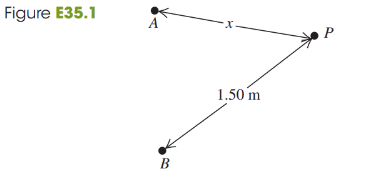
Two small stereo speakers A and B that are 1.40 m apart are sending out sound of wavelength 34 cm in all directions and all in phase. A person at point P starts out equidistant from both speakers and walks so that he is always 1.50 m from speaker B (Fig. E35.1). For what values of x will the sound this person hears be maximally reinforced? Limit your solution to the cases where x ≤ 1.50 m.

검증된 단계별 안내
1
Step 1: Understand the problem setup. The speakers A and B are separated by a distance of 1.40 m and emit sound waves in phase with a wavelength of 34 cm (0.34 m). The person at point P is always 1.50 m away from speaker B and moves along a path such that the distance from speaker A changes. We need to find the values of x (distance from speaker A) where the sound is maximally reinforced, meaning constructive interference occurs.
Step 2: Recall the condition for constructive interference. Constructive interference happens when the path difference between the sound waves from the two speakers is an integer multiple of the wavelength. Mathematically, this is expressed as: ΔL = nλ, where ΔL is the path difference, n is an integer (0, 1, 2, ...), and λ is the wavelength.
Step 3: Express the path difference. The path difference ΔL is given by the absolute difference between the distances from the person to each speaker: ΔL = |L_A - L_B|, where L_A is the distance from speaker A to point P and L_B is the distance from speaker B to point P. Since L_B is fixed at 1.50 m, we can write ΔL = |x - 1.50|.
Step 4: Substitute the condition for constructive interference into the path difference equation. For constructive interference, |x - 1.50| = nλ. Substitute λ = 0.34 m into the equation: |x - 1.50| = n(0.34). Solve for x: x = 1.50 ± n(0.34).
Step 5: Limit the solution to the given range. The problem specifies that x ≤ 1.50 m. Therefore, calculate the possible values of x for integer values of n (starting from n = 0) that satisfy this condition. For each value of n, check if x ≤ 1.50 m and list the corresponding values of x.

비슷한 문제에 대한 검증된 영상 답변:

이 영상 해법은 위 문제에 도움이 된다고 튜터들이 추천한 것입니다.
영상 길이:
9m
도움이 되었나요?

주요 개념

질문에 올바르게 답하기 위해 반드시 이해해야 하는 핵심 개념들은 다음과 같습니다.

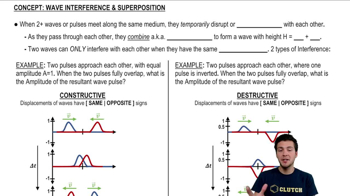
Wave Interference

Wave interference occurs when two or more waves overlap and combine to form a new wave pattern. This can result in constructive interference, where waves align to amplify the sound, or destructive interference, where they cancel each other out. In this scenario, the sound waves from speakers A and B will interfere based on their path differences to point P.
추천 영상:
가이드 코스
03:47
Wave Interference & Superposition

Path Difference

The path difference is the difference in distance traveled by two waves from their sources to a common point. For constructive interference to occur, this path difference must be an integer multiple of the wavelength. In this case, the distances from speakers A and B to point P will determine the path difference and thus the reinforcement of sound at point P.
추천 영상:

Wavelength and Frequency

Wavelength is the distance between successive crests of a wave, and it is inversely related to frequency, which is the number of wave cycles that pass a point per second. In this problem, the wavelength of 34 cm is crucial for calculating the conditions for constructive interference, as it helps determine the specific distances at which the sound will be maximally reinforced.
추천 영상:
가이드 코스
05:08
Circumference, Period, and Frequency in UCM