
Ch 35: Interference
Young & Freedman Calc - University Physics 14th Edition
Young & Freedman Calc14th EditionUniversity PhysicsISBN: 9780321973610당신이 사용하는 게 아니라요?교과서 변경
35장, 문제 2c

Two speakers that are 15.0 m apart produce in-phase sound waves of frequency 250.0 Hz in a room where the speed of sound is 340.0 m/s. A woman starts out at the midpoint between the two speakers. The room's walls and ceiling are covered with absorbers to eliminate reflections, and she listens with only one ear for best precision. How far from the center must she walk before she first hears the sound maximally enhanced?

검증된 단계별 안내
1
Step 1: Understand the concept of constructive interference. Constructive interference occurs when two sound waves meet in phase, meaning their crests and troughs align perfectly, resulting in a maximally enhanced sound. This happens when the path difference between the two waves is an integer multiple of the wavelength.
Step 2: Calculate the wavelength of the sound waves using the formula \( \lambda = \frac{v}{f} \), where \( v \) is the speed of sound (340.0 m/s) and \( f \) is the frequency of the sound waves (250.0 Hz).
Step 3: Determine the condition for constructive interference. The path difference between the sound waves from the two speakers must equal \( n \lambda \), where \( n \) is an integer (starting from \( n = 1 \) for the first maximum).
Step 4: Set up the geometry of the problem. The woman starts at the midpoint between the two speakers, so the initial path difference is zero. As she moves away from the center, the path difference changes. Use the Pythagorean theorem to express the distances from the woman to each speaker as functions of her position.
Step 5: Solve for the position where the path difference equals \( \lambda \) (the first maximum). This involves equating the difference in distances from the woman to each speaker to \( \lambda \). Simplify the equation and solve for the distance she must walk from the center.

비슷한 문제에 대한 검증된 영상 답변:

이 영상 해법은 위 문제에 도움이 된다고 튜터들이 추천한 것입니다.
영상 길이:
9m
도움이 되었나요?

주요 개념

질문에 올바르게 답하기 위해 반드시 이해해야 하는 핵심 개념들은 다음과 같습니다.

Interference of Sound Waves

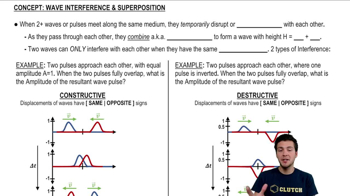
Interference occurs when two or more sound waves overlap, resulting in a new wave pattern. In this scenario, the two speakers produce in-phase sound waves, meaning their peaks and troughs align. This can lead to constructive interference, where the sound waves reinforce each other, creating areas of increased sound intensity, known as antinodes.
추천 영상:
03:47
Wave Interference & Superposition

Path Difference

Path difference refers to the difference in distance traveled by sound waves from two sources to a given point. For constructive interference to occur, the path difference must be an integer multiple of the wavelength. In this case, the woman must walk a certain distance from the midpoint to achieve the necessary path difference for the sound waves from both speakers to arrive in phase.
추천 영상:
08:20
Mean Free Path

Wavelength and Frequency Relationship

The wavelength of a sound wave is inversely related to its frequency, as described by the equation v = fλ, where v is the speed of sound, f is the frequency, and λ is the wavelength. For the given frequency of 250 Hz and speed of sound at 340 m/s, calculating the wavelength is essential to determine how far the woman must walk to experience the first maximum in sound intensity.
추천 영상:
05:08
Circumference, Period, and Frequency in UCM
관련 실천
교과서 질문

Two speakers that are 15.0 m apart produce in-phase sound waves of frequency 250.0 Hz in a room where the speed of sound is 340.0 m/s. A woman starts out at the midpoint between the two speakers. The room's walls and ceiling are covered with absorbers to eliminate reflections, and she listens with only one ear for best precision. What does she hear: constructive or destructive interference? Why?

2078
views
교과서 질문

Two small stereo speakers A and B that are 1.40 m apart are sending out sound of wavelength 34 cm in all directions and all in phase. A person at point P starts out equidistant from both speakers and walks so that he is always 1.50 m from speaker B (Fig. E35.1). For what values of x will the sound this person hears be cancelled? Limit your solution to the cases where x ≤ 1.50 m.

1729
views
교과서 질문

Two speakers, emitting identical sound waves of wavelength 2.0 m in phase with each other, and an observer are located as shown in Fig. E35.5. At the observer's location, what is the path difference for waves from the two speakers?

4449
views
1
rank
교과서 질문

Two small stereo speakers A and B that are 1.40 m apart are sending out sound of wavelength 34 cm in all directions and all in phase. A person at point P starts out equidistant from both speakers and walks so that he is always 1.50 m from speaker B (Fig. E35.1). For what values of x will the sound this person hears be maximally reinforced? Limit your solution to the cases where x ≤ 1.50 m.

2086
views
1
rank
교과서 질문

Two radio antennas A and B radiate in phase. Antenna B is 120 m to the right of antenna A. Consider point Q along the extension of the line connecting the antennas, a horizontal distance of 40 m to the right of antenna B. The frequency, and hence the wavelength, of the emitted waves can be varied. What is the longest wavelength for which there will be destructive interference at point Q?

2401
views
1
rank
교과서 질문

Two radio antennas A and B radiate in phase. Antenna B is 120 m to the right of antenna A. Consider point Q along the extension of the line connecting the antennas, a horizontal distance of 40 m to the right of antenna B. The frequency, and hence the wavelength, of the emitted waves can be varied. What is the longest wavelength for which there will be constructive interference at point Q?

1740
views
1
rank