Ch 38: Photons: Light Waves Behaving as Particles
Young & Freedman Calc - University Physics 14th Edition
Young & Freedman Calc14th EditionUniversity PhysicsISBN: 9780321973610당신이 사용하는 게 아니라요?교과서 변경
38장, 문제 5b

A photon has momentum of magnitude 8.24×10−288.24\(\times\)10^{-28} kg-m/s. What is the wavelength of this photon? In what region of the electromagnetic spectrum does it lie?

검증된 단계별 안내
1
Step 1: Recall the relationship between the momentum of a photon and its wavelength. The equation is given by \( p = \frac{h}{\lambda} \), where \( p \) is the momentum, \( h \) is Planck's constant (\( 6.626 \times 10^{-34} \, \text{J} \cdot \text{s} \)), and \( \lambda \) is the wavelength.
Step 2: Rearrange the equation to solve for the wavelength \( \lambda \). This gives \( \lambda = \frac{h}{p} \).
Step 3: Substitute the given values into the equation. The momentum \( p \) is \( 8.24 \times 10^{-28} \, \text{kg} \cdot \text{m/s} \), and \( h \) is \( 6.626 \times 10^{-34} \, \text{J} \cdot \text{s} \). Ensure the units are consistent.
Step 4: Perform the division \( \lambda = \frac{6.626 \times 10^{-34}}{8.24 \times 10^{-28}} \) to calculate the wavelength. This will yield the wavelength in meters.
Step 5: Determine the region of the electromagnetic spectrum by comparing the calculated wavelength to known ranges of wavelengths for different regions (e.g., gamma rays, X-rays, ultraviolet, visible light, infrared, microwaves, and radio waves).

비슷한 문제에 대한 검증된 영상 답변:

이 영상 해법은 위 문제에 도움이 된다고 튜터들이 추천한 것입니다.
영상 길이:
3m

주요 개념

질문에 올바르게 답하기 위해 반드시 이해해야 하는 핵심 개념들은 다음과 같습니다.

Photon Momentum

Photons, despite having no mass, carry momentum, which is given by the formula p = E/c, where p is momentum, E is energy, and c is the speed of light. This relationship highlights the wave-particle duality of light, where photons exhibit both wave-like and particle-like properties.
추천 영상:
가이드 코스
05:17
Intro to Momentum

Wavelength and Frequency Relationship

The wavelength (λ) of a photon is inversely related to its frequency (ν) through the equation c = λν, where c is the speed of light. This means that as the wavelength increases, the frequency decreases, and vice versa, which is crucial for determining the characteristics of electromagnetic radiation.
추천 영상:
가이드 코스
05:08
Circumference, Period, and Frequency in UCM

Electromagnetic Spectrum

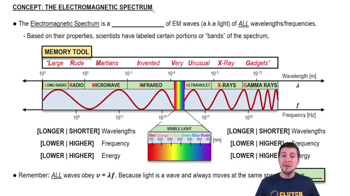
The electromagnetic spectrum encompasses all types of electromagnetic radiation, ranging from radio waves to gamma rays. Each type of radiation is characterized by its wavelength and frequency, and the position of a photon within this spectrum determines its energy and potential applications in technology and science.
추천 영상:
가이드 코스
06:06
The Electromagnetic Spectrum