
Ch 38: Photons: Light Waves Behaving as Particles
Young & Freedman Calc - University Physics 14th Edition
Young & Freedman Calc14th EditionUniversity PhysicsISBN: 9780321973610당신이 사용하는 게 아니라요?교과서 변경
38장, 문제 10a

The photoelectric work function of potassium is 2.32.3 eV. If light that has a wavelength of 190190 nm falls on potassium, find the stopping potential in volts.

검증된 단계별 안내
1
First, understand the concept of the photoelectric effect. When light falls on a material, it can eject electrons if the energy of the photons is greater than the work function of the material. The stopping potential is the potential needed to stop these ejected electrons.
Calculate the energy of the incoming photons using the formula: \( E = \frac{hc}{\lambda} \), where \( h \) is Planck's constant \( (6.626 \times 10^{-34} \text{ Js}) \), \( c \) is the speed of light \( (3 \times 10^8 \text{ m/s}) \), and \( \lambda \) is the wavelength of the light \( (190 \text{ nm} = 190 \times 10^{-9} \text{ m}) \).
Convert the energy of the photons from joules to electron volts (eV) using the conversion factor \( 1 \, \text{eV} = 1.602 \, imes 10^{-19} \, \text{J} \).
Determine the kinetic energy of the ejected electrons using the equation: \( KE = E_{photon} - \text{work function} \). The work function of potassium is given as 2.3 eV.
The stopping potential \( V_s \) is equal to the kinetic energy of the ejected electrons divided by the charge of an electron. Use the formula: \( V_s = \frac{KE}{e} \), where \( e \) is the elementary charge \( (1.602 \times 10^{-19} \text{ C}) \).

비슷한 문제에 대한 검증된 영상 답변:

이 영상 해법은 위 문제에 도움이 된다고 튜터들이 추천한 것입니다.
영상 길이:
4m
도움이 되었나요?

주요 개념

질문에 올바르게 답하기 위해 반드시 이해해야 하는 핵심 개념들은 다음과 같습니다.

Photoelectric Effect

The photoelectric effect occurs when light shines on a material and ejects electrons from its surface. The energy of the incoming photons must be greater than the material's work function to release electrons. This phenomenon is crucial for understanding how light can cause electron emission and is foundational in quantum physics.
추천 영상:
가이드 코스
07:40
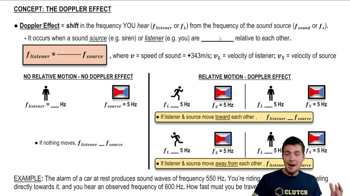
The Doppler Effect

Work Function

The work function is the minimum energy required to remove an electron from the surface of a material. It is specific to each material and is measured in electron volts (eV). In the context of the photoelectric effect, the work function determines the threshold frequency or wavelength of light needed to eject electrons.
추천 영상:
가이드 코스
08:30
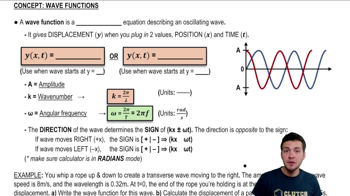
Intro to Wave Functions

Stopping Potential

Stopping potential is the voltage required to stop the most energetic photoelectrons emitted from a material due to the photoelectric effect. It is calculated using the energy difference between the incoming photons and the work function. The stopping potential provides insight into the kinetic energy of the emitted electrons.
추천 영상:
가이드 코스
07:12
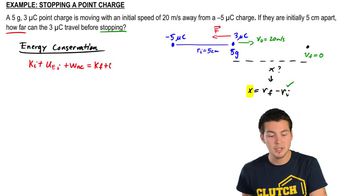
Distance to Stop a Point Charge