Ch 43: Nuclear Physics
Young & Freedman Calc - University Physics 14th Edition
Young & Freedman Calc14th EditionUniversity PhysicsISBN: 9780321973610당신이 사용하는 게 아니라요?교과서 변경
43장, 문제 1

How many protons and how many neutrons are there in a nucleus of the most common isotope of (a) silicon, 01428Si^{28}_{\(\phantom{0}\)14}Si; (b) rubidium, 03785Rb^{85}_{\(\phantom{0}\)37}Rb; (c) thallium, 081205Tl^{205}_{\(\phantom{0}\)81}Tl?

검증된 단계별 안내
1
Step 1: Understand the notation used for isotopes. The isotope notation is typically written as A/Z Element, where A is the mass number (total number of protons and neutrons), Z is the atomic number (number of protons), and 'Element' is the chemical symbol. For example, 01428Si^{28}_{14}Si represents silicon with a mass number of 28 and an atomic number of 14.
Step 2: Determine the number of protons in the nucleus. The atomic number (Z) directly gives the number of protons in the nucleus. For (a) silicon, Z = 14, so there are 14 protons. For (b) rubidium, Z = 37, so there are 37 protons. For (c) thallium, Z = 81, so there are 81 protons.
Step 3: Calculate the number of neutrons in the nucleus. The number of neutrons is given by subtracting the atomic number (Z) from the mass number (A). Use the formula: n=A-Z. For (a) silicon, n = 28 - 14 = 14 neutrons. For (b) rubidium, n = 85 - 37 = 48 neutrons. For (c) thallium, n = 205 - 81 = 124 neutrons.
Step 4: Summarize the findings for each isotope. For (a) silicon, the nucleus contains 14 protons and 14 neutrons. For (b) rubidium, the nucleus contains 37 protons and 48 neutrons. For (c) thallium, the nucleus contains 81 protons and 124 neutrons.
Step 5: Verify the calculations and ensure the understanding of isotope notation. Double-check the subtraction for neutrons and confirm the atomic numbers using a periodic table to ensure accuracy.

비슷한 문제에 대한 검증된 영상 답변:

이 영상 해법은 위 문제에 도움이 된다고 튜터들이 추천한 것입니다.
도움이 되었나요?

주요 개념

질문에 올바르게 답하기 위해 반드시 이해해야 하는 핵심 개념들은 다음과 같습니다.

Atomic Structure

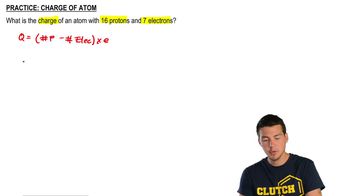
The atomic structure consists of protons, neutrons, and electrons. Protons and neutrons reside in the nucleus, while electrons orbit around it. The number of protons defines the element, while the number of neutrons can vary, leading to different isotopes of the same element.
추천 영상:

Isotopes

Isotopes are variants of a chemical element that have the same number of protons but different numbers of neutrons. This difference in neutron count affects the atomic mass but not the chemical properties. For example, silicon-28 has 14 protons and 14 neutrons, while silicon-29 has 14 protons and 15 neutrons.

Nuclear Notation

Nuclear notation is a shorthand representation of an isotope, indicating the element's symbol, the number of protons (atomic number) as a subscript, and the total number of nucleons (protons + neutrons) as a superscript. For instance, in the notation ^{28}_{14}Si, 14 is the number of protons, and 28 indicates the total number of protons and neutrons.
추천 영상:
가이드 코스
03:55
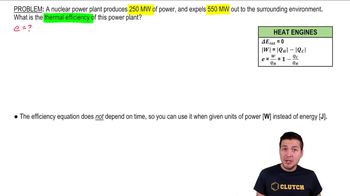
Efficiency of a Nuclear Power Plant