Ch 44: Particle Physics and Cosmology
Young & Freedman Calc - University Physics 14th Edition
Young & Freedman Calc14th EditionUniversity PhysicsISBN: 9780321973610당신이 사용하는 게 아니라요?교과서 변경
44장, 문제 4b

A proton and an antiproton annihilate, producing two photons. Find the energy, frequency, and wavelength of each photon if the pp and p\(\overline{p}\) collide head-on, each with an initial kinetic energy of 620620 MeV.

검증된 단계별 안내
1
Understand the problem: When a proton and an antiproton annihilate, their total energy (rest energy + kinetic energy) is converted into the energy of the two photons. The energy of each photon can be determined using the principle of conservation of energy.
Step 1: Calculate the total energy of the proton and antiproton. The rest energy of a proton (or antiproton) is given by Einstein's equation: \( E_{rest} = m c^2 \), where \( m \) is the mass of the proton (\( 1.67 \times 10^{-27} \; \text{kg} \)) and \( c \) is the speed of light (\( 3.00 \times 10^8 \; \text{m/s} \)). Add the given kinetic energy (620 MeV) to the rest energy to find the total energy of each particle.
Step 2: Use the conservation of energy principle. The total energy of the system before annihilation is the sum of the total energies of the proton and antiproton. Since the two photons share this energy equally, divide the total energy by 2 to find the energy of each photon.
Step 3: Relate the energy of each photon to its frequency using the Planck-Einstein relation: \( E = h f \), where \( h \) is Planck's constant (\( 6.63 \times 10^{-34} \; \text{J·s} \)) and \( f \) is the frequency. Rearrange the equation to solve for \( f \): \( f = \frac{E}{h} \).
Step 4: Relate the frequency of each photon to its wavelength using the wave equation: \( c = \lambda f \), where \( \lambda \) is the wavelength and \( c \) is the speed of light. Rearrange the equation to solve for \( \lambda \): \( \lambda = \frac{c}{f} \).

비슷한 문제에 대한 검증된 영상 답변:

이 영상 해법은 위 문제에 도움이 된다고 튜터들이 추천한 것입니다.
도움이 되었나요?

주요 개념

질문에 올바르게 답하기 위해 반드시 이해해야 하는 핵심 개념들은 다음과 같습니다.

Mass-Energy Equivalence

Mass-energy equivalence, expressed by Einstein's equation E=mc², states that mass can be converted into energy and vice versa. In particle physics, this principle is crucial when considering the annihilation of particles, such as a proton and an antiproton, where their mass is converted into energy in the form of photons.
추천 영상:
가이드 코스
4:52
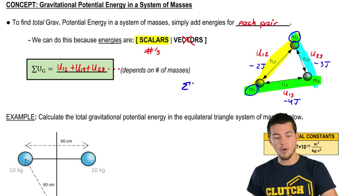
Gravitational Potential Energy for Systems of Masses

Photon Energy

The energy of a photon is directly related to its frequency and inversely related to its wavelength, described by the equation E=hf, where E is energy, h is Planck's constant, and f is frequency. This relationship allows us to calculate the energy of the photons produced in the annihilation process based on the total energy available from the colliding particles.
추천 영상:
가이드 코스
04:10
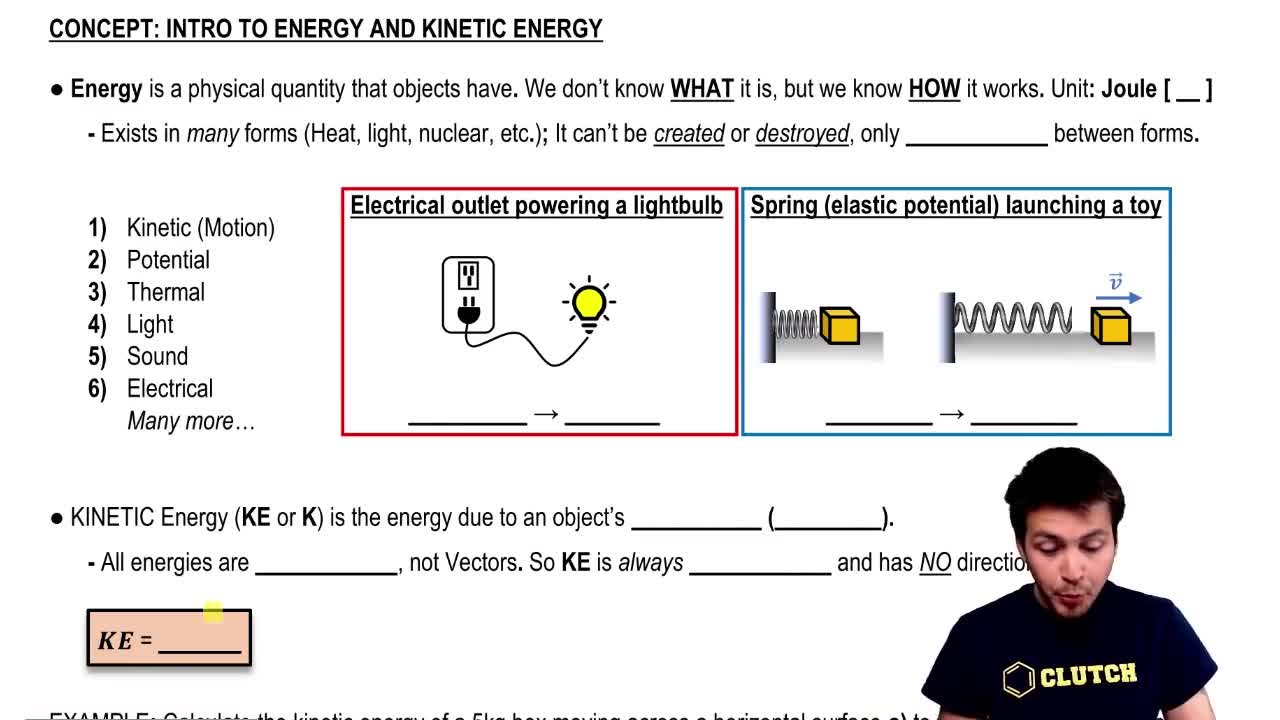
Intro to Energy & Types of Energy

Kinetic Energy in Particle Collisions

In particle collisions, the total energy is the sum of the rest mass energy and the kinetic energy of the particles involved. For the proton and antiproton with 620 MeV of kinetic energy each, this total energy must be considered when calculating the resulting energy of the photons produced during their annihilation, as it contributes significantly to the energy available for conversion into photon energy.
추천 영상:
가이드 코스
09:25
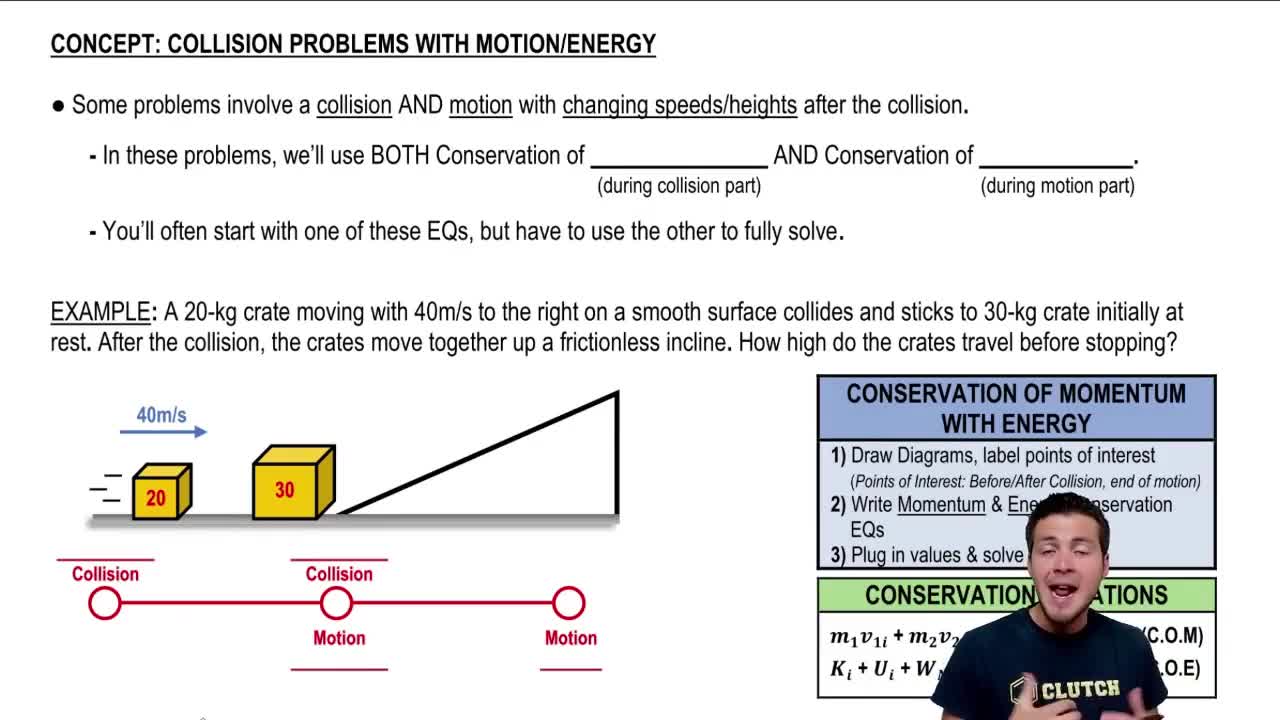
Collision Problems with Motion/Energy
관련 실천
교과서 질문

Deuterons in a cyclotron travel in a circle with radius 32.032.0 cm just before emerging from the dees. The frequency of the applied alternating voltage is 9.009.00 MHz. Find the magnetic field.

1471
views

교과서 질문

The starship Enterprise, of television and movie fame, is powered by combining matter and antimatter. If the entire 400400-kg antimatter fuel supply of the Enterprise combines with matter, how much energy is released? How does this compare to the U.S. yearly energy use, which is roughly 1.0×10201.0\(\times\)10^{20} J?

2053
views
교과서 질문

A proton and an antiproton annihilate, producing two photons. Find the energy, frequency, and wavelength of each photon if the pp and p\(\overline{p}\) are initially at rest.

1983
views
교과서 질문

Two equal-energy photons collide head-on and annihilate each other, producing a µ+µµ^+µ^- pair. The muon mass is given in terms of the electron mass in Section 44.144.1. Calculate the maximum wavelength of the photons for this to occur. If the photons have this wavelength, describe the motion of the µ+ µ^+ and immediately after they are produced.

1406
views
교과서 질문

An electron with a total energy of 30.030.0 GeV collides with a stationary positron. What is the available energy?

1412
views
교과서 질문

A neutral pion at rest decays into two photons. Find the energy, frequency, and wavelength of each photon. In which part of the electromagnetic spectrum does each photon lie? (Use the pion mass given in terms of the electron mass in Section 44.144.1.)

2052
views