Ch 44: Particle Physics and Cosmology
Young & Freedman Calc - University Physics 14th Edition
Young & Freedman Calc14th EditionUniversity PhysicsISBN: 9780321973610당신이 사용하는 게 아니라요?교과서 변경
44장, 문제 1

A neutral pion at rest decays into two photons. Find the energy, frequency, and wavelength of each photon. In which part of the electromagnetic spectrum does each photon lie? (Use the pion mass given in terms of the electron mass in Section 44.144.1.)

검증된 단계별 안내
1
Step 1: Begin by understanding the decay process. A neutral pion at rest decays into two photons. Since the pion is initially at rest, its total energy is equal to its rest energy, which is given by Einstein's equation: Epion = mpionc2. The energy of the pion is distributed equally between the two photons due to conservation of energy and momentum.
Step 2: Use the mass of the pion provided in Section 44.1, expressed in terms of the electron mass. The mass of the pion is approximately mpion ≈ 273 melectron. Multiply this by the electron mass (melectron ≈ 9.11 × 10⁻³¹ kg) and substitute into the rest energy formula to find the total energy of the pion.
Step 3: Divide the total energy of the pion equally between the two photons. Since the pion is at rest, the photons are emitted in opposite directions with equal energy. The energy of each photon is therefore: Ephoton = Epion/2.
Step 4: Relate the energy of each photon to its frequency using Planck's equation: Ephoton = hν, where h is Planck's constant (h ≈ 6.63 × 10⁻³⁴ J·s) and ν is the frequency of the photon. Solve for ν using the energy calculated in Step 3.
Step 5: Calculate the wavelength of each photon using the relationship between frequency and wavelength: λ = c/ν, where c is the speed of light (c ≈ 3.00 × 10⁸ m/s). Finally, identify the part of the electromagnetic spectrum to which the photons belong based on their calculated wavelength.

비슷한 문제에 대한 검증된 영상 답변:

이 영상 해법은 위 문제에 도움이 된다고 튜터들이 추천한 것입니다.
영상 길이:
3m
도움이 되었나요?

주요 개념

질문에 올바르게 답하기 위해 반드시 이해해야 하는 핵심 개념들은 다음과 같습니다.

Energy-Mass Equivalence

Energy-mass equivalence, described by Einstein's equation E=mc², states that mass can be converted into energy and vice versa. In the context of particle decay, the rest mass of the neutral pion is converted into the energy of the resulting photons. This principle is crucial for calculating the energy of the photons produced in the decay process.
추천 영상:
가이드 코스
4:52
Gravitational Potential Energy for Systems of Masses

Photon Properties

Photons are massless particles that carry electromagnetic radiation. Each photon has energy (E), frequency (f), and wavelength (λ) related by the equations E=hf and c=fλ, where h is Planck's constant and c is the speed of light. Understanding these relationships is essential for determining the energy, frequency, and wavelength of the photons resulting from the pion decay.
추천 영상:
가이드 코스
08:45
Properties of Cyclic Thermodynamic Processes

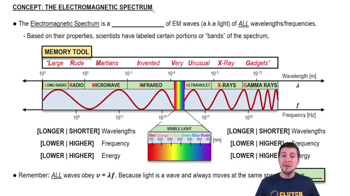
Electromagnetic Spectrum

The electromagnetic spectrum encompasses all types of electromagnetic radiation, ranging from radio waves to gamma rays. Each type of radiation is characterized by its wavelength and frequency. Identifying the part of the spectrum where the photons lie requires calculating their wavelengths and comparing them to known ranges, which helps in understanding their physical properties and applications.
추천 영상:
가이드 코스
06:06
The Electromagnetic Spectrum