Ch. 1 - Introduction to Statistics
Larson - Elementary Statistics: Picturing the World 8th Edition
Larson8th EditionElementary Statistics: Picturing the WorldISBN: 9780137493470당신이 사용하는 게 아니라요?교과서 변경
1장, 문제 1.2.9

Determine whether the data are qualitative or quantitative. Explain your reasoning.
Ages of dogs at a rescue facility

검증된 단계별 안내
1
Step 1: Understand the difference between qualitative and quantitative data. Qualitative data describes attributes or characteristics and is non-numerical (e.g., colors, names, types). Quantitative data represents numerical values that can be measured or counted (e.g., height, weight, age).
Step 2: Analyze the given data, which is 'Ages of dogs at a rescue facility.' The term 'ages' refers to a numerical measurement that represents how old the dogs are.
Step 3: Determine whether the data is numerical or descriptive. Since 'ages' are expressed in numbers (e.g., 2 years, 5 years), this data is numerical.
Step 4: Conclude that numerical data is quantitative because it can be measured and used for mathematical operations such as addition, subtraction, or averaging.
Step 5: Final reasoning: The data 'Ages of dogs at a rescue facility' is quantitative because it represents numerical values that measure the age of each dog.

비슷한 문제에 대한 검증된 영상 답변:

이 영상 해법은 위 문제에 도움이 된다고 튜터들이 추천한 것입니다.
영상 길이:
1m
도움이 되었나요?

주요 개념

질문에 올바르게 답하기 위해 반드시 이해해야 하는 핵심 개념들은 다음과 같습니다.

Qualitative Data

Qualitative data refers to non-numeric information that describes characteristics or qualities. This type of data is often categorical, meaning it can be divided into groups based on attributes, such as colors, names, or types. In the context of the question, qualitative data would involve descriptions of the dogs, such as breed or temperament.
추천 영상:
가이드 코스
04:39
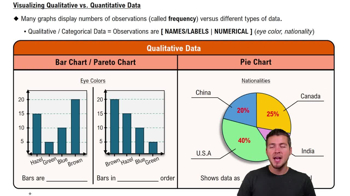
Visualizing Qualitative vs. Quantitative Data

Quantitative Data

Quantitative data consists of numeric values that can be measured and analyzed statistically. This type of data can be further classified into discrete data, which can take specific values (like the number of dogs), and continuous data, which can take any value within a range (like height or weight). The ages of dogs, as mentioned in the question, are an example of quantitative data since they can be expressed in numbers.
추천 영상:
가이드 코스
04:39
Visualizing Qualitative vs. Quantitative Data

Data Classification

Data classification is the process of categorizing data into distinct types based on their characteristics. Understanding whether data is qualitative or quantitative is essential for selecting appropriate statistical methods for analysis. In this case, recognizing that the ages of dogs are numerical allows for the application of various statistical techniques to analyze and interpret the data effectively.
추천 영상:
가이드 코스
04:39
Visualizing Qualitative vs. Quantitative Data