

Ch. 1 - Introduction to Statistics
Larson - Elementary Statistics: Picturing the World 8th Edition
Larson8th EditionElementary Statistics: Picturing the WorldISBN: 9780137493470당신이 사용하는 게 아니라요?교과서 변경
1장, 문제 1.2.1

Name each level of measurement for which data can be qualitative.

검증된 단계별 안내
1
Understand the concept of qualitative data: Qualitative data refers to non-numeric information that describes categories or characteristics. Examples include colors, names, labels, or any data that cannot be measured numerically.
Review the four levels of measurement: Nominal, Ordinal, Interval, and Ratio. These levels classify data based on their properties and the types of operations that can be performed on them.
Identify which levels of measurement can be qualitative: Nominal and Ordinal levels are used for qualitative data. Nominal data represents categories without any order (e.g., gender, hair color), while Ordinal data represents categories with a meaningful order but without consistent intervals (e.g., rankings like 'poor', 'average', 'excellent').
Exclude Interval and Ratio levels: Interval and Ratio levels are used for quantitative data, which involves numeric values and measurable quantities. These levels are not applicable for qualitative data.
Summarize the answer: The levels of measurement for which data can be qualitative are Nominal and Ordinal.

비슷한 문제에 대한 검증된 영상 답변:

이 영상 해법은 위 문제에 도움이 된다고 튜터들이 추천한 것입니다.
영상 길이:
4m
도움이 되었나요?

주요 개념

질문에 올바르게 답하기 위해 반드시 이해해야 하는 핵심 개념들은 다음과 같습니다.

Levels of Measurement

Levels of measurement refer to the different ways in which data can be categorized and quantified. The four primary levels are nominal, ordinal, interval, and ratio. For qualitative data, the relevant levels are nominal and ordinal, which focus on categorizing data without a specific numerical value.
추천 영상:
가이드 코스
10:28
Difference in Proportions: Hypothesis Tests Example 1

Nominal Measurement

Nominal measurement is the simplest level of measurement, where data is categorized into distinct groups without any order or ranking. Examples include gender, race, or types of cuisine. In nominal data, the categories are mutually exclusive and collectively exhaustive, meaning each data point fits into one category only.
추천 영상:
가이드 코스
04:39
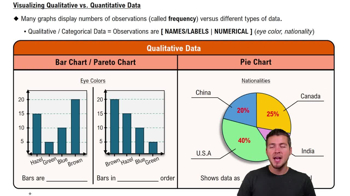
Visualizing Qualitative vs. Quantitative Data

Ordinal Measurement

Ordinal measurement involves categorizing data into ordered groups, where the order matters but the differences between the ranks are not uniform. An example is a satisfaction survey with ratings like 'satisfied,' 'neutral,' and 'dissatisfied.' While we can rank these categories, we cannot quantify the exact difference between them.
추천 영상:
가이드 코스
04:39
Visualizing Qualitative vs. Quantitative Data