
Ch. 3 - Probability
Larson - Elementary Statistics: Picturing the World 8th Edition
Larson8th EditionElementary Statistics: Picturing the WorldISBN: 9780137493470당신이 사용하는 게 아니라요?교과서 변경
3장, 문제 3.1.2d

2. Determine whether each number could represent the probability of an event. Explain your reasoning. d. -0.0004

검증된 단계별 안내
1
Understand the definition of probability: Probability is a measure of the likelihood of an event occurring, and it is always a value between 0 and 1, inclusive. This means that probabilities cannot be negative or exceed 1.
Examine the given number: The problem provides the value -0.0004, which is a negative number.
Compare the given number to the valid range for probabilities: Since probabilities must be between 0 and 1, inclusive, any negative number is not a valid probability.
Explain the reasoning: The value -0.0004 cannot represent the probability of an event because it falls outside the valid range for probabilities (0 ≤ P ≤ 1).
Conclude: Based on the definition of probability and the given value, -0.0004 is not a valid probability.

비슷한 문제에 대한 검증된 영상 답변:

이 영상 해법은 위 문제에 도움이 된다고 튜터들이 추천한 것입니다.
영상 길이:
1m
도움이 되었나요?

주요 개념

질문에 올바르게 답하기 위해 반드시 이해해야 하는 핵심 개념들은 다음과 같습니다.

Probability Range

Probability is a measure of the likelihood of an event occurring, and it is always expressed as a number between 0 and 1. A probability of 0 indicates that an event will not occur, while a probability of 1 indicates certainty that the event will occur. Any number outside this range, such as negative values or values greater than 1, cannot represent a valid probability.
추천 영상:
5:37
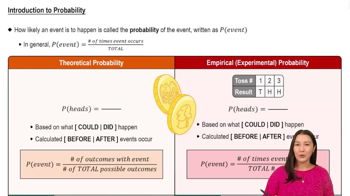
Introduction to Probability

Negative Numbers in Probability

Negative numbers are not valid in the context of probability because they do not have a meaningful interpretation in this framework. Probabilities must reflect a non-negative measure of likelihood, and a negative value, like -0.0004, suggests an impossibility or an error in calculation, making it unsuitable for representing the chance of any event.
추천 영상:
5:37
Introduction to Probability

Interpretation of Probabilities

Understanding how to interpret probabilities is crucial for analyzing events. Probabilities provide a quantitative way to express uncertainty and are used in various fields, including statistics and risk assessment. Recognizing that probabilities must be non-negative helps in evaluating whether a given number can logically represent the likelihood of an event.
추천 영상:
5:37
Introduction to Probability
관련 실천
교과서 질문

50. Investment Committee A company has 200 employees, consisting of 144 women and 56 men. The company wants to select five employees to serve as an investment committee.

d. Explain how the company can select a representative sample of the male and female population of employees.

71
views
교과서 질문

Using the Multiplication Rule In Exercises 19-32, use the Multiplication Rule.

25. Best President In a sample of 1500 adult U.S. citizens, 270 said that Barack Obama was the best president in U.S. history. Two adult U.S. citizens are selected at random.

(Adapted from YouGov)

d. Which of the events can be considered unusual? Explain.

99
views
교과서 질문

26. Eye Survey The table shows the results of a survey that asked 3203 people whether they wore contacts or glasses. A person is selected at random from the sample. Find the probability of each event.

d. The person is male or does not wear glasses.

" style="max-width: 100%; white-space-collapse: preserve;" width="480">

83
views
교과서 질문

22. Brexit A survey asked 1115 British adults how Britain's decision to leave the European Union has impacted the country. The results are shown in the Pareto chart. Find the

probability of each event. (Adapted from Ipsos)

d. Randomly selecting a British adult who feels that the move has had a fairly positive or very positive impact on Great Britain

77
views
교과서 질문

Marijuana Use The percent distribution of the last marijuana use (either medical or nonmedical) for a sample of 13,373 college students is shown in the pie chart. Find the

probability of each event. (Source: American College Health Association)

d. Randomly selecting a student who has not used marijuana within the last 12 months

84
views