
Ch. 3 - Probability
Larson - Elementary Statistics: Picturing the World 8th Edition
Larson8th EditionElementary Statistics: Picturing the WorldISBN: 9780137493470당신이 사용하는 게 아니라요?교과서 변경
3장, 문제 3.4.25

25. Playlist A band is preparing a setlist of 21 songs for a concert. How many different ways can the band play the first six songs?

검증된 단계별 안내
1
Step 1: Recognize that the problem involves arranging a subset of songs (6 songs) from a larger set (21 songs). This is a permutation problem because the order in which the songs are played matters.
Step 2: Recall the formula for permutations, which is P(n, r) = n! / (n - r)!, where n is the total number of items (21 songs) and r is the number of items to arrange (6 songs).
Step 3: Substitute the values into the formula: P(21, 6) = 21! / (21 - 6)!. This simplifies to P(21, 6) = 21! / 15!.
Step 4: Simplify the factorial expression by canceling out the common terms in the numerator and denominator. Specifically, 21! = 21 × 20 × 19 × 18 × 17 × 16 × 15!, so the 15! in the numerator and denominator cancel out, leaving P(21, 6) = 21 × 20 × 19 × 18 × 17 × 16.
Step 5: Multiply the remaining terms (21 × 20 × 19 × 18 × 17 × 16) to find the total number of permutations. This will give the total number of ways the band can arrange the first six songs.

비슷한 문제에 대한 검증된 영상 답변:

이 영상 해법은 위 문제에 도움이 된다고 튜터들이 추천한 것입니다.
영상 길이:
2m

주요 개념

질문에 올바르게 답하기 위해 반드시 이해해야 하는 핵심 개념들은 다음과 같습니다.

Permutations

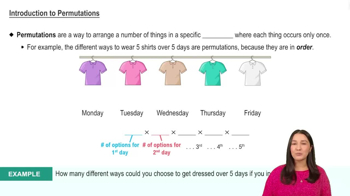
Permutations refer to the different arrangements of a set of items where the order matters. In this context, since the band is selecting and arranging the first six songs from a total of 21, the number of permutations will determine how many unique sequences can be formed.
추천 영상:
가이드 코스
07:11
Introduction to Permutations

Factorial Notation

Factorial notation, denoted as n!, represents the product of all positive integers up to n. It is crucial for calculating permutations, as the number of ways to arrange k items from n is given by the formula n! / (n-k)!, where k is the number of items to arrange.
추천 영상:
가이드 코스
07:11
Introduction to Permutations

Combinatorial Counting

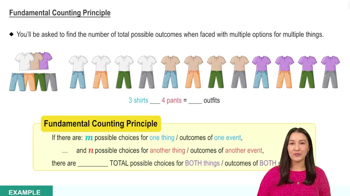
Combinatorial counting involves techniques for counting the arrangements or selections of items in a set. Understanding this concept helps in determining how many different ways the band can choose and order the first six songs from their setlist of 21.
추천 영상:
가이드 코스
04:04
Fundamental Counting Principle
관련 실천
교과서 질문

Using a Pie Chart to Find Probabilities In Exercises 83-86, use the pie chart at the left, which shows the number of workers (in millions) by occupation for the United States. (Source: U.S. Bureau of Labor Statistics)

84. Find the probability that a worker chosen at random is not employed in a service occupation.

" style="" width="260">

126
views
교과서 질문

34. Lottery Number Selection A lottery has 52 numbers. In how many different ways can six of the numbers be selected? (Assume the order of selection is not important.)

126
views
교과서 질문

"Classifying Events as Independent or Dependent In Exercises 9-14, determine whether the events are independent or dependent. Explain your reasoning.

13. Rolling a six-sided die and then rolling the die a second time so that the sum of the two rolls is five"

65
views
교과서 질문

True or False? In Exercises 3-6, determine whether the statement is true or false. If it is false,

explain why.

4. When two events are independent, they are also mutually exclusive.

150
views
교과서 질문

Graphical Analysis In Exercises 7 and 8, determine whether the events shown in the Venn diagram are mutually exclusive. Explain your reasoning.

130
views
교과서 질문

Identifying the Sample Space of a Probability Experiment In Exercises 25-32, identify the sample space of the probability experiment and determine the number of outcomes in the sample space. Draw a tree diagram when appropriate.

25. Guessing the initial of a student's middle name

160
views