Ch. 3 - Probability
Larson - Elementary Statistics: Picturing the World 8th Edition
Larson8th EditionElementary Statistics: Picturing the WorldISBN: 9780137493470당신이 사용하는 게 아니라요?교과서 변경
3장, 문제 3.3.4

True or False? In Exercises 3-6, determine whether the statement is true or false. If it is false,
explain why.
4. When two events are independent, they are also mutually exclusive.

검증된 단계별 안내
1
Step 1: Begin by understanding the definitions of 'independent events' and 'mutually exclusive events'. Independent events are those where the occurrence of one event does not affect the probability of the other event occurring. Mathematically, this is expressed as P(A ∩ B) = P(A) * P(B). Mutually exclusive events, on the other hand, are events that cannot occur at the same time. Mathematically, this means P(A ∩ B) = 0.
Step 2: Analyze the relationship between these two concepts. If two events are mutually exclusive, the probability of their intersection (both occurring simultaneously) is zero. However, for independent events, the probability of their intersection is generally non-zero unless one of the events has a probability of zero.
Step 3: Consider an example to clarify the distinction. Suppose Event A is 'rolling a 3 on a die' and Event B is 'rolling a 4 on the same die'. These events are mutually exclusive because you cannot roll both a 3 and a 4 in a single roll. However, they are not independent because the occurrence of one event does not affect the occurrence of the other—they are mutually exclusive instead.
Step 4: Reflect on whether independence and mutual exclusivity can coexist. If two events are mutually exclusive, the occurrence of one event means the other cannot occur, which violates the definition of independence. Therefore, mutually exclusive events cannot be independent.
Step 5: Conclude that the statement 'When two events are independent, they are also mutually exclusive' is false. Provide reasoning that independence and mutual exclusivity are distinct concepts and cannot occur simultaneously.

비슷한 문제에 대한 검증된 영상 답변:

이 영상 해법은 위 문제에 도움이 된다고 튜터들이 추천한 것입니다.
영상 길이:
5m
도움이 되었나요?

주요 개념

질문에 올바르게 답하기 위해 반드시 이해해야 하는 핵심 개념들은 다음과 같습니다.

Independent Events

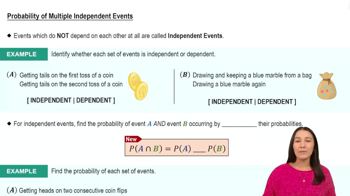
Independent events are those whose occurrence or non-occurrence does not affect the probability of the other event occurring. For example, flipping a coin and rolling a die are independent events because the outcome of one does not influence the outcome of the other.
추천 영상:
05:54
Probability of Multiple Independent Events

Mutually Exclusive Events

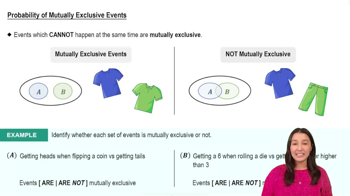
Mutually exclusive events are events that cannot occur at the same time. For instance, when flipping a coin, the outcomes 'heads' and 'tails' are mutually exclusive because if one occurs, the other cannot. This concept is crucial in probability as it affects how we calculate the likelihood of combined events.
추천 영상:
5:14
Probability of Mutually Exclusive Events

Relationship Between Independence and Mutual Exclusivity

The relationship between independent and mutually exclusive events is that they are fundamentally different. While independent events can occur simultaneously without affecting each other's probabilities, mutually exclusive events cannot occur together at all. Therefore, if two events are independent, they cannot be mutually exclusive.
추천 영상:
5:14
Probability of Mutually Exclusive Events
관련 실천
교과서 질문

25. Playlist A band is preparing a setlist of 21 songs for a concert. How many different ways can the band play the first six songs?

129
views

교과서 질문

3. What does the notation P(B|A) mean?

278
views
교과서 질문

Odds The chances of winning are often written in terms of odds rather than probabilities. The odds of winning is the ratio of the number of successful outcomes to the number of unsuccessful outcomes. The odds of losing is the ratio of the number of unsuccessful outcomes to the number of successful outcomes. For example, when the number of successful outcomes is 2 and the number of unsuccessful outcomes is 3, the odds of winning are 2 : 3 (read "2 to 3"). In Exercises 91-96, use this information about odds.

92. The probability of winning an instant prize game is 1/10. The odds of winning a different instant prize game are 1 : 10. You want the best chance of winning. Which game should you play? Explain your reasoning.

61
views
교과서 질문

Finding Classical Probabilities In Exercises 41-46, a probability experiment consists of rolling a 12-sided die numbered 1 to 12. Find the probability of the event.

46. Event F: rolling a number divisible by 5

120
views
교과서 질문

Graphical Analysis In Exercises 7 and 8, determine whether the events shown in the Venn diagram are mutually exclusive. Explain your reasoning.

130
views
교과서 질문

Identifying the Sample Space of a Probability Experiment In Exercises 25-32, identify the sample space of the probability experiment and determine the number of outcomes in the sample space. Draw a tree diagram when appropriate.

25. Guessing the initial of a student's middle name

160
views