Ch. 3 - Probability
Larson - Elementary Statistics: Picturing the World 8th Edition
Larson8th EditionElementary Statistics: Picturing the WorldISBN: 9780137493470당신이 사용하는 게 아니라요?교과서 변경
3장, 문제 3.4.56

56. Defective Disks A pack of 100 recordable DVDs contains 5 defective disks. You select four disks. What is the probability of selecting at least three non defective disks?

검증된 단계별 안내
1
Step 1: Identify the total number of disks (N = 100), the number of defective disks (D = 5), and the number of non-defective disks (N - D = 95). You are selecting 4 disks, and the goal is to find the probability of selecting at least 3 non-defective disks.
Step 2: Break the problem into two cases: (1) selecting exactly 3 non-defective disks and 1 defective disk, and (2) selecting all 4 non-defective disks. Use the hypergeometric probability formula for each case: P(X = k) = (C(G, k) * C(B, n - k)) / C(N, n), where G is the number of non-defective disks, B is the number of defective disks, N is the total number of disks, n is the number of disks selected, and k is the number of non-defective disks selected.
Step 3: For case 1 (exactly 3 non-defective disks), calculate the number of ways to choose 3 non-defective disks from 95 and 1 defective disk from 5. This is given by: C(95, 3) * C(5, 1). Then divide by the total number of ways to choose 4 disks from 100: C(100, 4).
Step 4: For case 2 (all 4 non-defective disks), calculate the number of ways to choose 4 non-defective disks from 95. This is given by: C(95, 4). Then divide by the total number of ways to choose 4 disks from 100: C(100, 4).
Step 5: Add the probabilities from case 1 and case 2 to find the total probability of selecting at least 3 non-defective disks. This is P(X = 3) + P(X = 4).

비슷한 문제에 대한 검증된 영상 답변:

이 영상 해법은 위 문제에 도움이 된다고 튜터들이 추천한 것입니다.
영상 길이:
7m
도움이 되었나요?

주요 개념

질문에 올바르게 답하기 위해 반드시 이해해야 하는 핵심 개념들은 다음과 같습니다.

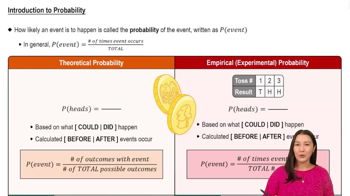
Probability

Probability is a measure of the likelihood that a particular event will occur, expressed as a number between 0 and 1. In this context, it helps determine the chances of selecting a certain number of non-defective disks from a pack. Understanding basic probability principles, such as combinations and the complement rule, is essential for solving problems involving random selections.
추천 영상:
가이드 코스
5:37
Introduction to Probability

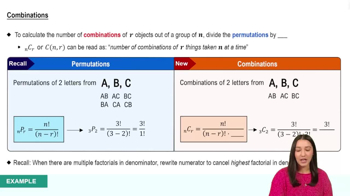
Combinations

Combinations refer to the selection of items from a larger set where the order does not matter. In this scenario, we need to calculate how many ways we can choose non-defective disks from the total available. The formula for combinations, denoted as C(n, k) = n! / (k!(n-k)!), is crucial for determining the number of successful outcomes in probability calculations.
추천 영상:

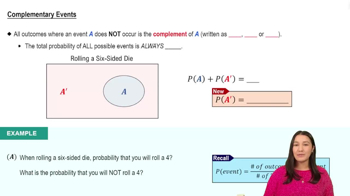
Complement Rule

The complement rule in probability states that the probability of an event occurring is equal to 1 minus the probability of it not occurring. In this question, calculating the probability of selecting at least three non-defective disks can be simplified by first finding the probability of selecting fewer than three non-defective disks and subtracting that from one. This approach often makes complex probability problems more manageable.
추천 영상:
가이드 코스
4:23
Complementary Events
관련 실천
교과서 질문

3. Explain why the statement is incorrect: The probability of rain is 150%.

156
views

교과서 질문

Identifying Simple Events In Exercises 33-36, determine the number of outcomes in the event. Then decide whether the event is a simple event or not. Explain your reasoning.

34. A spreadsheet is used to randomly generate a number from 1 to 4000. Event B is generating a number less than 500.

112
views
교과서 질문

Using a Tree Diagram In Exercises 67-70, a probability experiment consists of rolling a six-sided die and spinning the spinner shown at the left. The spinner is equally likely to land on each color. Use a tree diagram to find the probability of the event. Then explain whether the event can be considered unusual.

68. Event B: rolling an odd number and the spinner landing on green

87
views
교과서 질문

"According to Bayes’ Theorem, the probability of event A , given that event B has occurred, is

P(A|B) = P(A) * P(B|A)P(A) * P(B|A) + P(A') * P(B|A').

In Exercises 33–38, use Bayes’ Theorem to find P(A|B).

36. P(A) = 0.62, P(A') = 0.38, P(B|A) = 0.41 , and P(B|A') = 0.17 "

104
views
교과서 질문

In Exercises 15-18, determine whether the situation involves permutations, combinations, or neither. Explain your reasoning.

17. The number of ways 2 captains can be chosen from 28 players on a lacrosse team

150
views
교과서 질문

"Classifying Events as Independent or Dependent In Exercises 9-14, determine whether the events are independent or dependent. Explain your reasoning.

10. A father having hazel eyes and a daughter having hazel eyes"

69
views