
Ch. 3 - Probability
Larson - Elementary Statistics: Picturing the World 8th Edition
Larson8th EditionElementary Statistics: Picturing the WorldISBN: 9780137493470당신이 사용하는 게 아니라요?교과서 변경
3장, 문제 3.2.38

"According to Bayes’ Theorem, the probability of event A , given that event B has occurred, is
P(A|B) = P(A) * P(B|A)P(A) * P(B|A) + P(A') * P(B|A').
In Exercises 33–38, use Bayes’ Theorem to find P(A|B).
38. P(A) = 12%, P(A') = 88%, P(B|A) = 66% , and P(B|A') = 19% "

검증된 단계별 안내
1
Step 1: Recall Bayes' Theorem formula: P(A|B) = (P(A) * P(B|A)) / (P(A) * P(B|A) + P(A') * P(B|A')). This formula helps calculate the probability of event A occurring given that event B has occurred.
Step 2: Identify the given probabilities from the problem: P(A) = 0.12, P(A') = 0.88, P(B|A) = 0.66, and P(B|A') = 0.19.
Step 3: Substitute the given values into the numerator of the formula: P(A) * P(B|A) = 0.12 * 0.66.
Step 4: Substitute the given values into the denominator of the formula: P(A) * P(B|A) + P(A') * P(B|A') = (0.12 * 0.66) + (0.88 * 0.19).
Step 5: Divide the result of the numerator by the result of the denominator to find P(A|B). This will give you the probability of event A occurring given that event B has occurred.

비슷한 문제에 대한 검증된 영상 답변:

이 영상 해법은 위 문제에 도움이 된다고 튜터들이 추천한 것입니다.
영상 길이:
2m
도움이 되었나요?

주요 개념

질문에 올바르게 답하기 위해 반드시 이해해야 하는 핵심 개념들은 다음과 같습니다.

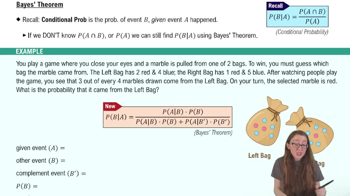
Bayes' Theorem

Bayes' Theorem is a fundamental principle in probability theory that describes how to update the probability of a hypothesis based on new evidence. It states that the probability of event A given event B (P(A|B)) can be calculated using the formula P(A|B) = P(A) * P(B|A) / (P(A) * P(B|A) + P(A') * P(B|A')). This theorem is particularly useful in scenarios where prior knowledge about the events is available.
추천 영상:
05:10
Bayes' Theorem

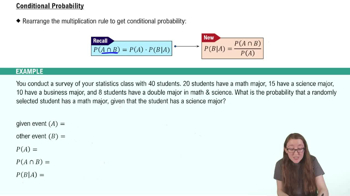
Conditional Probability

Conditional probability is the measure of the probability of an event occurring given that another event has already occurred. It is denoted as P(A|B), which represents the probability of event A occurring under the condition that event B is true. Understanding conditional probability is crucial for applying Bayes' Theorem, as it allows us to assess how the occurrence of one event influences the likelihood of another.
추천 영상:
03:53
Conditional Probability Rule

Prior and Posterior Probabilities

In the context of Bayes' Theorem, prior probability refers to the initial assessment of the likelihood of an event before new evidence is considered (P(A)), while posterior probability is the updated probability after taking into account the new evidence (P(A|B)). The distinction between these two types of probabilities is essential for understanding how new information can change our beliefs about the likelihood of events.
추천 영상:
5:37
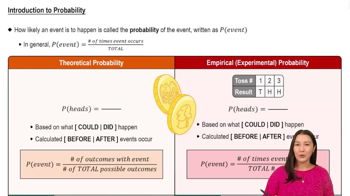
Introduction to Probability
관련 실천
교과서 질문

"Using the Multiplication Rule In Exercises 19-32, use the Multiplication Rule.

22.Pickup Trucks In a survey, 510 U.S. adults were asked whether they drive a pickup truck and whether they drive a Ford. The results showed that three in twenty adults surveyed drive a Ford. Of the adults surveyed that drive Fords, nine in twenty drive a pickup truck. Find the probability that a randomly selected adult drives a Ford and drives a pickup truck.

82
views
교과서 질문

"Identifying the Sample Space of a Probability Experiment In Exercises 25-32, identify the sample space of the probability experiment and determine the number of outcomes in the sample space. Draw a tree diagram when appropriate.

26. Guessing a student's letter grade (A, B, C, D, F) in a class

"

120
views
교과서 질문

True or False? In Exercises 7-10, determine whether the statement is true or false. If it is false, rewrite it as a true statement.

9. A probability of 1/10 indicates an unusual event.

102
views
교과서 질문

Classifying Types of Probability In Exercises 53-58, classify the statement as an example of classical probability, empirical probability, or subjective probability. Explain your reasoning.

58. You estimate that the probability of getting all the classes you want on your next schedule

is about 25%.

150
views
교과서 질문

28. Necklaces You are putting nine blue glass beads, three red glass beads, and seven green glass beads on a necklace. In how many distinguishable ways can the colored beads be put on the necklace?

186
views
교과서 질문

"True or False? In Exercises 3-6, determine whether the statement is true or false. If it is false,

explain why.

3. When two events are mutually exclusive, they have no outcomes in common."

63
views