
Ch. 3 - Probability
Larson - Elementary Statistics: Picturing the World 8th Edition
Larson8th EditionElementary Statistics: Picturing the WorldISBN: 9780137493470당신이 사용하는 게 아니라요?교과서 변경
3장, 문제 3.1.58

Classifying Types of Probability In Exercises 53-58, classify the statement as an example of classical probability, empirical probability, or subjective probability. Explain your reasoning.
58. You estimate that the probability of getting all the classes you want on your next schedule
is about 25%.

검증된 단계별 안내
1
Understand the three types of probability: Classical probability is based on equally likely outcomes, empirical probability is based on observed data or experiments, and subjective probability is based on personal judgment or estimation.
Analyze the given statement: 'You estimate that the probability of getting all the classes you want on your next schedule is about 25%.'
Notice that the probability is described as an estimate, which is not derived from observed data or a formal calculation of equally likely outcomes.
Recognize that this estimate is based on personal judgment or belief, rather than empirical evidence or a theoretical framework.
Classify the statement as an example of subjective probability because it relies on personal estimation rather than data or mathematical reasoning.

비슷한 문제에 대한 검증된 영상 답변:

이 영상 해법은 위 문제에 도움이 된다고 튜터들이 추천한 것입니다.
영상 길이:
2m
도움이 되었나요?

주요 개념

질문에 올바르게 답하기 위해 반드시 이해해야 하는 핵심 개념들은 다음과 같습니다.

Classical Probability

Classical probability is based on the assumption that all outcomes in a sample space are equally likely. It is calculated by dividing the number of favorable outcomes by the total number of possible outcomes. For example, the probability of rolling a three on a fair six-sided die is 1/6, as there is one favorable outcome and six possible outcomes.
추천 영상:
5:37
Introduction to Probability

Empirical Probability

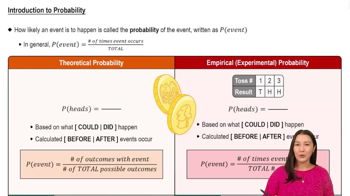
Empirical probability, also known as experimental probability, is determined by conducting experiments or observing real-world events. It is calculated by taking the ratio of the number of times an event occurs to the total number of trials. For instance, if you flip a coin 100 times and it lands on heads 55 times, the empirical probability of getting heads is 55/100 or 0.55.
추천 영상:
5:37
Introduction to Probability

Subjective Probability

Subjective probability is based on personal judgment, intuition, or experience rather than on exact calculations or empirical data. It reflects an individual's belief about the likelihood of an event occurring. For example, estimating a 25% chance of getting all desired classes in a schedule is a subjective probability, as it relies on personal assessment rather than statistical analysis.
추천 영상:
5:37
Introduction to Probability
관련 실천
교과서 질문

Using a Bar Graph to Find Probabilities In Exercises 75-78, use the bar graph at the left, which shows the highest level of education received by employees of a company. Find the probability that the highest level of education for an employee chosen at random is

77. a master's degree.

157
views
교과서 질문

"Identifying the Sample Space of a Probability Experiment In Exercises 25-32, identify the sample space of the probability experiment and determine the number of outcomes in the sample space. Draw a tree diagram when appropriate.

26. Guessing a student's letter grade (A, B, C, D, F) in a class

"

120
views
교과서 질문

True or False? In Exercises 7-10, determine whether the statement is true or false. If it is false, rewrite it as a true statement.

9. A probability of 1/10 indicates an unusual event.

102
views
교과서 질문

"According to Bayes’ Theorem, the probability of event A , given that event B has occurred, is

P(A|B) = P(A) * P(B|A)P(A) * P(B|A) + P(A') * P(B|A').

In Exercises 33–38, use Bayes’ Theorem to find P(A|B).

38. P(A) = 12%, P(A') = 88%, P(B|A) = 66% , and P(B|A') = 19% "

80
views
교과서 질문

28. Necklaces You are putting nine blue glass beads, three red glass beads, and seven green glass beads on a necklace. In how many distinguishable ways can the colored beads be put on the necklace?

186
views
교과서 질문

"True or False? In Exercises 3-6, determine whether the statement is true or false. If it is false,

explain why.

3. When two events are mutually exclusive, they have no outcomes in common."

63
views