
Ch. 3 - Probability
Larson - Elementary Statistics: Picturing the World 8th Edition
Larson8th EditionElementary Statistics: Picturing the WorldISBN: 9780137493470당신이 사용하는 게 아니라요?교과서 변경
3장, 문제 3.3.3

"True or False? In Exercises 3-6, determine whether the statement is true or false. If it is false,
explain why.
3. When two events are mutually exclusive, they have no outcomes in common."

검증된 단계별 안내
1
Understand the concept of mutually exclusive events: Two events are mutually exclusive if they cannot occur at the same time. This means that the occurrence of one event excludes the possibility of the other event occurring.
Consider the definition of mutually exclusive events in terms of their intersection: Mathematically, two events A and B are mutually exclusive if their intersection is empty, i.e., A ∩ B = ∅. This means there are no outcomes that belong to both events.
Analyze the statement: The statement claims that mutually exclusive events have no outcomes in common. Based on the definition of mutually exclusive events, this is true because their intersection is empty.
If the statement were false, we would need to provide a counterexample. However, since the definition of mutually exclusive events inherently means no shared outcomes, the statement aligns with the definition.
Conclude that the statement is true, as it directly reflects the definition of mutually exclusive events having no outcomes in common.

비슷한 문제에 대한 검증된 영상 답변:

이 영상 해법은 위 문제에 도움이 된다고 튜터들이 추천한 것입니다.
영상 길이:
2m
도움이 되었나요?

주요 개념

질문에 올바르게 답하기 위해 반드시 이해해야 하는 핵심 개념들은 다음과 같습니다.

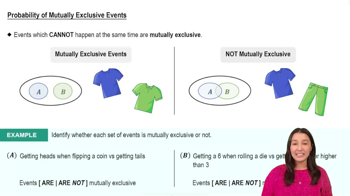
Mutually Exclusive Events

Mutually exclusive events are those that cannot occur at the same time. If one event happens, the other cannot. For example, when flipping a coin, the outcomes 'heads' and 'tails' are mutually exclusive because both cannot occur simultaneously.
추천 영상:
5:14
Probability of Mutually Exclusive Events

Sample Space

The sample space is the set of all possible outcomes of a random experiment. Understanding the sample space is crucial for determining whether events are mutually exclusive, as it helps identify if there are any common outcomes between the events in question.
추천 영상:
05:11
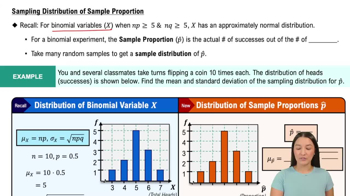
Sampling Distribution of Sample Proportion

Probability

Probability is a measure of the likelihood that an event will occur, expressed as a number between 0 and 1. In the context of mutually exclusive events, the probability of either event occurring is the sum of their individual probabilities, reinforcing the concept that they cannot happen at the same time.
추천 영상:
5:37
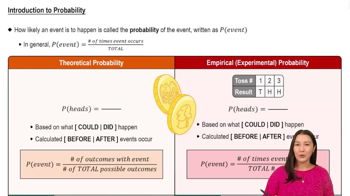
Introduction to Probability