Ch. 4 - Probability
Triola - Elementary Statistics 14th Edition
Triola14th EditionElementary StatisticsISBN: 9780137366446당신이 사용하는 게 아니라요?교과서 변경
4장, 문제 4.4.4

Combination Lock The typical combination lock uses three numbers, each between 0 and 49. Opening the lock requires entry of the three numbers in the correct order. Is the name “combination” lock appropriate? Why or why not?

검증된 단계별 안내
1
Step 1: Understand the difference between a combination and a permutation. A combination refers to selecting items where the order does not matter, while a permutation refers to selecting items where the order does matter.
Step 2: Analyze the problem. The lock requires the three numbers to be entered in a specific order to open it. This means the order of the numbers is crucial.
Step 3: Determine whether the term 'combination' is appropriate. Since the order of the numbers matters in this scenario, the term 'combination' is not technically correct. The correct term would be 'permutation.'
Step 4: Calculate the total number of possible permutations for the lock. Since there are three numbers to be entered, each between 0 and 49, the total number of permutations can be calculated using the formula for permutations: \( n^r \), where \( n \) is the number of choices for each position and \( r \) is the number of positions. Here, \( n = 50 \) and \( r = 3 \).
Step 5: Conclude that the name 'combination lock' is a misnomer because the lock operates based on permutations, not combinations, as the order of the numbers is essential.

비슷한 문제에 대한 검증된 영상 답변:

이 영상 해법은 위 문제에 도움이 된다고 튜터들이 추천한 것입니다.
영상 길이:
3m
도움이 되었나요?

주요 개념

질문에 올바르게 답하기 위해 반드시 이해해야 하는 핵심 개념들은 다음과 같습니다.

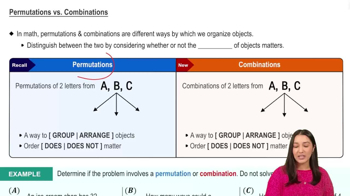
Permutations vs. Combinations

In statistics, permutations refer to the arrangement of items in a specific order, while combinations refer to the selection of items without regard to order. The term 'combination lock' is misleading because the order of the numbers matters for unlocking, which aligns with permutations rather than combinations.
추천 영상:
03:18
Permutations vs. Combinations

Sample Space

The sample space in probability is the set of all possible outcomes of a random experiment. For the combination lock, the sample space consists of all possible sequences of three numbers chosen from the range of 0 to 49, which amounts to 50 options for each number, leading to a total of 50^3 (125,000) possible combinations.
추천 영상:
05:11
Sampling Distribution of Sample Proportion

Order of Operations

The order of operations is crucial in determining the correct sequence in which to enter the numbers on a combination lock. Since the lock requires the numbers to be entered in a specific order, understanding this concept is essential to grasp why the term 'combination' is not appropriate, as it implies a disregard for the sequence.
추천 영상:
가이드 코스
03:50
Probabilities Between Two Values
관련 실천
교과서 질문

In Exercises 6–10, use the following results from tests of an experiment to test the effectiveness of an experimental vaccine for children (based on data from USA Today). Express all probabilities in decimal form.


Find the probability of randomly selecting 2 subjects without replacement and finding that they both developed flu.

167
views
교과서 질문

Cloud Seeding The “Florida Area Cumulus Experiment” was conducted by using silver iodide to seed clouds with the objective of increasing rainfall. For the purposes of this exercise, let the daily amounts of rainfall be represented by units of rnfl. (The actual rainfall amounts are in or )

Find the value of the following statistics and include appropriate units based on rnfl as the unit of measurement.

15.53 7.27 7.45 10.39 4.70 4.50 3.44 5.70 8.24 7.30 4.05 4.46


a. mean

b. median

98
views
교과서 질문

Notation When randomly selecting a new smartphone, D denotes the event that it has a manufacturing defect. What do P(D) and P(D) represent?

195
views
교과서 질문

In Exercises 9–20, use the data in the following table, which lists survey results from high school drivers at least 16 years of age (based on data from “Texting While Driving and Other Risky Motor Vehicle Behaviors Among U.S. High School Students,” by O’Malley, Shults, and Eaton, Pediatrics, Vol. 131, No. 6). Assume that subjects are randomly selected from those included in the table. Hint: Be very careful to read the question correctly.

Texting and Alcohol If four different high school drivers are randomly selected, find the probability that they all texted while driving.

145
views
교과서 질문

In Exercises 13–20, express the indicated degree of likelihood as a probability value between 0 and 1.


Randomness When using a computer to randomly generate the last digit of a phone number to be called for a survey, there is 1 chance in 10 that the last digit is zero

177
views
교과서 질문

In Exercises 9–20, use the data in the following table, which lists survey results from high school drivers at least 16 years of age (based on data from “Texting While Driving and Other Risky Motor Vehicle Behaviors Among U.S. High School Students,” by O’Malley, Shults, and Eaton, Pediatrics, Vol. 131, No. 6). Assume that subjects are randomly selected from those included in the table. Hint: Be very careful to read the question correctly.


Texting or Drinking If one of the high school drivers is randomly selected, find the probability of getting one who texted while driving or drove when drinking alcohol.

137
views