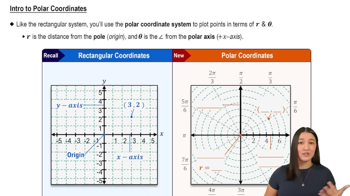
In Exercises 11–20, use a polar coordinate system like the one shown for Exercises 1–10 to plot each point with the given polar coordinates. (−2, − π/2)
Ch. 5 - Complex Numbers, Polar Coordinates and Parametric Equations

5장, 문제 19
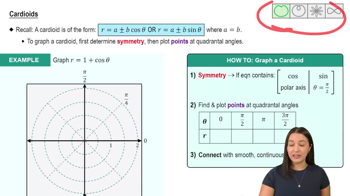
In Exercises 13–34, test for symmetry and then graph each polar equation. r = 2 + cos θ
검증된 단계별 안내1
Recall the three common tests for symmetry in polar coordinates: symmetry about the polar axis (x-axis), symmetry about the line \( \theta = \frac{\pi}{2} \) (y-axis), and symmetry about the pole (origin).
To test symmetry about the polar axis, replace \( \theta \) with \( -\theta \) in the equation and check if the equation remains unchanged. For \( r = 2 + \cos \theta \), substitute \( -\theta \) to get \( r = 2 + \cos(-\theta) \). Since \( \cos(-\theta) = \cos \theta \), the equation is unchanged, so the graph is symmetric about the polar axis.
To test symmetry about the line \( \theta = \frac{\pi}{2} \), replace \( \theta \) with \( \pi - \theta \) and check if the equation remains unchanged. Substitute \( \pi - \theta \) into the equation: \( r = 2 + \cos(\pi - \theta) \). Use the identity \( \cos(\pi - \theta) = -\cos \theta \) to rewrite it as \( r = 2 - \cos \theta \). Since this is not the same as the original equation, the graph is not symmetric about the line \( \theta = \frac{\pi}{2} \).
To test symmetry about the pole (origin), replace \( r \) with \( -r \) and \( \theta \) with \( \theta + \pi \), then check if the equation remains unchanged. Substitute to get \( -r = 2 + \cos(\theta + \pi) \). Using \( \cos(\theta + \pi) = -\cos \theta \), this becomes \( -r = 2 - \cos \theta \), or equivalently \( r = -2 + \cos \theta \). Since this differs from the original equation, the graph is not symmetric about the pole.
After determining the symmetries, sketch the graph by plotting points for various values of \( \theta \) between 0 and \( 2\pi \), calculating \( r = 2 + \cos \theta \) for each, and then plotting these points in polar coordinates. Connect the points smoothly to visualize the curve.

비슷한 문제에 대한 검증된 영상 답변:
이 영상 해법은 위 문제에 도움이 된다고 튜터들이 추천한 것입니다.
영상 길이:
6m도움이 되었나요?
주요 개념
질문에 올바르게 답하기 위해 반드시 이해해야 하는 핵심 개념들은 다음과 같습니다.
Polar Coordinates and Equations
Polar coordinates represent points using a radius r and an angle θ from the positive x-axis. Polar equations express r as a function of θ, describing curves in the plane. Understanding how to interpret and plot these equations is essential for graphing polar curves.
추천 영상:
Intro to Polar Coordinates
Symmetry Tests in Polar Graphs
Symmetry in polar graphs can be tested about the polar axis, the line θ = π/2, and the pole (origin). These tests involve substituting θ with -θ, π - θ, or replacing r with -r to check if the equation remains unchanged, helping to simplify graphing and understand the curve's shape.
추천 영상:
Cardioids
Graphing Polar Equations Involving Cosine
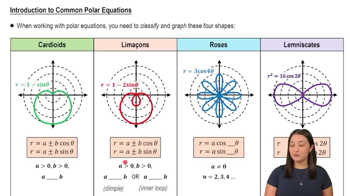
Polar equations with cosine terms, like r = 2 + cos θ, often produce limaçon shapes. Recognizing how the cosine function affects the radius for different θ values aids in plotting key points and sketching the curve accurately, including identifying loops or dimpled features.
추천 영상:
Introduction to Common Polar Equations
관련 실천
교과서 질문
702
views
교과서 질문
In Exercises 11–26, plot each complex number. Then write the complex number in polar form. You may express the argument in degrees or radians. −3
434
views
교과서 질문
In Exercises 19–21, find the product of the complex numbers. Leave answers in polar form.
z₁ = 3(cos 40°+i sin 40°)
z₂ = 5(cos 70°+i sin 70°)
526
views
교과서 질문
In Exercises 9–20, use point plotting to graph the plane curve described by the given parametric equations. Use arrows to show the orientation of the curve corresponding to increasing values of t. x = 2t, y = |t − 1|; −∞ < t < ∞
756
views
교과서 질문
In Exercises 13–34, test for symmetry and then graph each polar equation. r = 1 + 2 cos θ
769
views
교과서 질문
In Exercises 9–20, find each product and write the result in standard form. (2 + 3i)²
690
views