Ch. 5 - Complex Numbers, Polar Coordinates and Parametric Equations
Blitzer - Trigonometry 3rd Edition
Blitzer3rd EditionTrigonometryISBN: 9780137316601당신이 사용하는 게 아니라요?교과서 변경
5장, 문제 21

In Exercises 21–28, divide and express the result in standard form. 2 / 3 - i

검증된 단계별 안내
1
Identify the complex number in the denominator: \(3 - i\).
To divide by a complex number, multiply both the numerator and denominator by the conjugate of the denominator. The conjugate of \(3 - i\) is \(3 + i\).
Multiply numerator and denominator by \(3 + i\): \(\frac{2}{3 - i} \times \frac{3 + i}{3 + i} = \frac{2(3 + i)}{(3 - i)(3 + i)}\).
Expand the numerator: \(2(3 + i) = 6 + 2i\).
Expand the denominator using the difference of squares formula: \((3 - i)(3 + i) = 3^2 - (i)^2 = 9 - (-1) = 9 + 1 = 10\).

비슷한 문제에 대한 검증된 영상 답변:

이 영상 해법은 위 문제에 도움이 된다고 튜터들이 추천한 것입니다.
영상 길이:
4m
도움이 되었나요?

주요 개념

질문에 올바르게 답하기 위해 반드시 이해해야 하는 핵심 개념들은 다음과 같습니다.

Complex Number Standard Form

A complex number is expressed in standard form as a + bi, where a is the real part and b is the imaginary part. Writing results in this form helps clearly separate the real and imaginary components, making it easier to interpret and use in further calculations.
추천 영상:
04:47
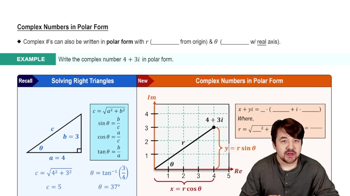
Complex Numbers In Polar Form

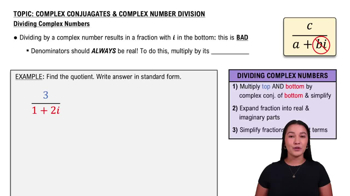
Division of Complex Numbers

Dividing complex numbers involves multiplying the numerator and denominator by the conjugate of the denominator to eliminate the imaginary part in the denominator. This process converts the division into a simpler form that can be expressed as a standard complex number.
추천 영상:
4:22
Dividing Complex Numbers

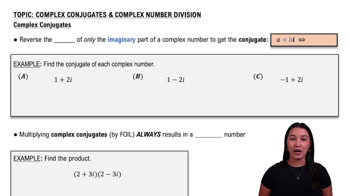
Complex Conjugate

The complex conjugate of a number a + bi is a - bi. Multiplying by the conjugate removes the imaginary part from the denominator because (a + bi)(a - bi) equals a² + b², a real number. This technique is essential for simplifying complex fractions.
추천 영상:
5:33
Complex Conjugates