In Exercises 21–40, eliminate the parameter t. Then use the rectangular equation to sketch the plane curve represented by the given parametric equations. Use arrows to show the orientation of the curve corresponding to increasing values of t. (If an interval for t is not specified, assume that −∞ < t < ∞. x = t, y = 2t
Ch. 5 - Complex Numbers, Polar Coordinates and Parametric Equations

5장, 문제 21
In Exercises 21–26, use a polar coordinate system like the one shown for Exercises 1–10 to plot each point with the given polar coordinates. Then find another representation of this point in which
a. r>0, 2π < θ < 4π.
b. r<0, 0. < θ < 2π.
c. r>0, −2π. < θ < 0.
(5, π/6)
검증된 단계별 안내1
Step 1: Understand the given point in polar coordinates: \(r = 5\), \(\theta = \frac{\pi}{6}\). This means the point is 5 units from the origin at an angle of \(\frac{\pi}{6}\) radians measured counterclockwise from the positive x-axis.
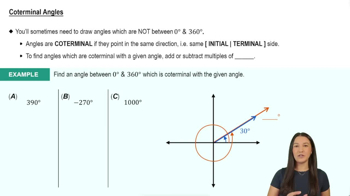
Step 2: For part (a), find another representation where \(r > 0\) and \(2\pi < \theta < 4\pi\). Since the angle can be coterminal by adding multiples of \(2\pi\), add \(2\pi\) to the original angle: \(\theta_{new} = \frac{\pi}{6} + 2\pi\).
Step 3: For part (b), find a representation where \(r < 0\) and \(0 < \theta < 2\pi\). To get a negative radius, use the fact that \((r, \theta)\) is equivalent to \((-r, \theta + \pi)\). So, set \(r_{new} = -5\) and \(\theta_{new} = \frac{\pi}{6} + \pi\).
Step 4: For part (c), find a representation where \(r > 0\) and \(-2\pi < \theta < 0\). To get a negative angle coterminal with \(\frac{\pi}{6}\), subtract \(2\pi\) from the original angle: \(\theta_{new} = \frac{\pi}{6} - 2\pi\).
Step 5: Summarize the new representations: (a) \((5, \frac{\pi}{6} + 2\pi)\), (b) \((-5, \frac{\pi}{6} + \pi)\), and (c) \((5, \frac{\pi}{6} - 2\pi)\). These satisfy the given conditions for \(r\) and \(\theta\).

비슷한 문제에 대한 검증된 영상 답변:
이 영상 해법은 위 문제에 도움이 된다고 튜터들이 추천한 것입니다.
영상 길이:
2m도움이 되었나요?
주요 개념
질문에 올바르게 답하기 위해 반드시 이해해야 하는 핵심 개념들은 다음과 같습니다.
Polar Coordinates and Their Representation
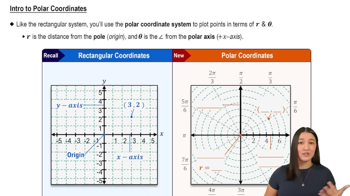
Polar coordinates represent points in a plane using a radius (r) and an angle (θ) measured from the positive x-axis. Each point can have multiple representations by adjusting r and θ, reflecting the same location in different ways. Understanding how to plot and interpret these coordinates is fundamental to solving the problem.
추천 영상:
Intro to Polar Coordinates
Angle Measurement and Periodicity
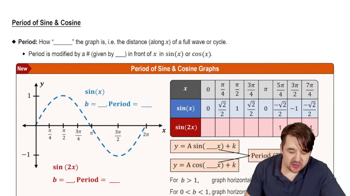
Angles in polar coordinates are periodic with a period of 2π, meaning adding or subtracting multiples of 2π results in the same direction. This property allows for multiple angle representations of the same point, especially when adjusting θ to fit within specified intervals like (2π, 4π) or (−2π, 0).
추천 영상:
Period of Sine and Cosine Functions
Negative Radius and Angle Adjustments
A negative radius (r < 0) in polar coordinates points in the opposite direction of the angle θ, effectively shifting the point by π radians. This concept is crucial when finding alternate representations with negative r, as it requires adjusting θ accordingly to maintain the point's position.
추천 영상:
Coterminal Angles
관련 실천
교과서 질문
753
views
교과서 질문
In Exercises 11–26, plot each complex number. Then write the complex number in polar form. You may express the argument in degrees or radians. −3
434
views
교과서 질문
In Exercises 21–28, divide and express the result in standard form. 2 / 3 - i
670
views
교과서 질문
In Exercises 21–28, divide and express the result in standard form.
3 / 4+i
495
views
교과서 질문
In Exercises 9–20, use point plotting to graph the plane curve described by the given parametric equations. Use arrows to show the orientation of the curve corresponding to increasing values of t. x = 2t, y = |t − 1|; −∞ < t < ∞
756
views
교과서 질문
In Exercises 13–34, test for symmetry and then graph each polar equation. r = 1 + 2 cos θ
769
views
