In Exercises 25–29, use DeMoivre's Theorem to find the indicated power of the complex number. Write answers in rectangular form. (−2 − 2i)⁵
Ch. 5 - Complex Numbers, Polar Coordinates and Parametric Equations

5장, 문제 27
In Exercises 21–40, eliminate the parameter t. Then use the rectangular equation to sketch the plane curve represented by the given parametric equations. Use arrows to show the orientation of the curve corresponding to increasing values of t. (If an interval for t is not specified, assume that −∞ < t < ∞.
x = 2 sin t, y = 2 cos t; 0 ≤ t < 2π
검증된 단계별 안내1
Identify the given parametric equations: \(x = 2 \sin t\) and \(y = 2 \cos t\), with the parameter \(t\) in the interval \(0 \leq t < 2\pi\).
Recall the Pythagorean identity: \(\sin^2 t + \cos^2 t = 1\). This identity will help us eliminate the parameter \(t\) by expressing \(\sin t\) and \(\cos t\) in terms of \(x\) and \(y\).
Express \(\sin t\) and \(\cos t\) from the parametric equations: \(\sin t = \frac{x}{2}\) and \(\cos t = \frac{y}{2}\).
Substitute these expressions into the Pythagorean identity to get the rectangular equation: \(\left(\frac{x}{2}\right)^2 + \left(\frac{y}{2}\right)^2 = 1\).
Simplify the equation to the standard form of a circle: \(\frac{x^2}{4} + \frac{y^2}{4} = 1\). This represents a circle centered at the origin with radius 2. To sketch the curve, draw this circle and use the parameter interval to determine the orientation, noting that as \(t\) increases from \(0\) to \(2\pi\), the point moves clockwise because \(x = 2 \sin t\) and \(y = 2 \cos t\).

비슷한 문제에 대한 검증된 영상 답변:
이 영상 해법은 위 문제에 도움이 된다고 튜터들이 추천한 것입니다.
영상 길이:
7m도움이 되었나요?
주요 개념
질문에 올바르게 답하기 위해 반드시 이해해야 하는 핵심 개념들은 다음과 같습니다.
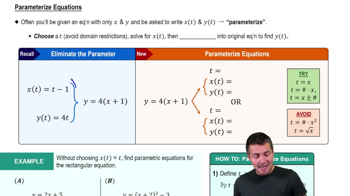
Parametric Equations
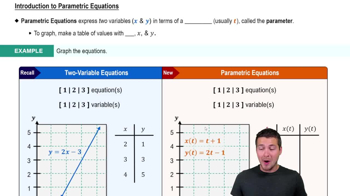
Parametric equations express the coordinates of points on a curve as functions of a parameter, often denoted as t. Instead of y as a function of x, both x and y depend on t, allowing the description of more complex curves and motions. Understanding how to manipulate these equations is key to analyzing the curve's shape and behavior.
추천 영상:
Parameterizing Equations
Eliminating the Parameter
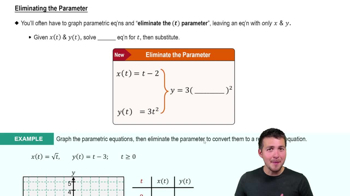
Eliminating the parameter involves rewriting the parametric equations to form a single equation in x and y, removing t. This is done by expressing t from one equation and substituting into the other or using trigonometric identities. This step converts the parametric form into a rectangular (Cartesian) equation, simplifying graphing and analysis.
추천 영상:
Eliminating the Parameter
Orientation and Sketching of Parametric Curves
Orientation refers to the direction in which the curve is traced as the parameter t increases. When sketching, arrows indicate this direction, helping to understand the curve's dynamic behavior. Recognizing the interval of t and how x and y change with t is essential for accurate graphing and interpretation.
추천 영상:
Introduction to Parametric Equations
관련 실천
교과서 질문
570
views
교과서 질문
In Exercises 27–32, select the representations that do not change the location of the given point. (7, 140°) (−7, 320°)
664
views
교과서 질문
In Exercises 27–32, select the representations that do not change the location of the given point. (4, 120°) (−4, 300°)
735
views
교과서 질문
In Exercises 25–29, use DeMoivre's Theorem to find the indicated power of the complex number. Write answers in rectangular form. [1/2 (cos π/14 + i sin π/14)]⁷
640
views
교과서 질문
In Exercises 25–29, use DeMoivre's Theorem to find the indicated power of the complex number. Write answers in rectangular form. _ (1−i√3)²
593
views
교과서 질문
In Exercises 27–36, write each complex number in rectangular form. If necessary, round to the nearest tenth. 6(cos 30° + i sin 30°)
525
views