Ch. 5 - Complex Numbers, Polar Coordinates and Parametric Equations
Blitzer - Trigonometry 3rd Edition
Blitzer3rd EditionTrigonometryISBN: 9780137316601당신이 사용하는 게 아니라요?교과서 변경
5장, 문제 27

In Exercises 27–32, select the representations that do not change the location of the given point. (7, 140°) (−7, 320°)

검증된 단계별 안내
1
Understand that the point is given in polar coordinates as \((r, \theta)\), where \(r\) is the radius (distance from the origin) and \(\theta\) is the angle measured in degrees from the positive x-axis.
Recall that changing the angle \(\theta\) by adding or subtracting full rotations of \(360^\circ\) does not change the point's location. So, \(\theta\) and \(\theta + 360^\circ k\) (where \(k\) is any integer) represent the same direction.
Note that changing the sign of \(r\) also affects the angle. Specifically, \((r, \theta)\) is equivalent to \((-r, \theta + 180^\circ)\) because moving in the opposite direction by \(180^\circ\) with a negative radius points to the same location.
For the point \((7, 140^\circ)\), check if representations keep the radius positive and adjust the angle by multiples of \(360^\circ\), or if the radius is negative, adjust the angle by adding \(180^\circ\) accordingly.
For the point \((-7, 320^\circ)\), similarly, consider adding or subtracting \(360^\circ\) to the angle, or converting the negative radius to positive by adding \(180^\circ\) to the angle, to find equivalent representations that do not change the point's location.

비슷한 문제에 대한 검증된 영상 답변:

이 영상 해법은 위 문제에 도움이 된다고 튜터들이 추천한 것입니다.
도움이 되었나요?

주요 개념

질문에 올바르게 답하기 위해 반드시 이해해야 하는 핵심 개념들은 다음과 같습니다.

Polar Coordinates

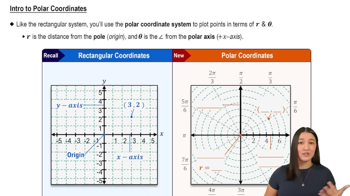
Polar coordinates represent points in a plane using a distance from the origin (radius) and an angle from the positive x-axis. A point is given as (r, θ), where r is the radius and θ is the angle in degrees or radians. Understanding this system is essential to interpret the given points correctly.
추천 영상:
05:32
Intro to Polar Coordinates

Equivalent Representations in Polar Coordinates

A single point in polar coordinates can have multiple representations by adjusting the radius and angle. For example, (r, θ) is equivalent to (−r, θ + 180°), or adding/subtracting full rotations (360°) to the angle. Recognizing these equivalences helps identify which transformations preserve the point's location.
추천 영상:
05:32
Intro to Polar Coordinates

Effect of Sign and Angle Changes on Point Location

Changing the sign of the radius or adding angles affects the point's position. A negative radius reverses the direction by 180°, while adding 360° to the angle results in the same direction. Understanding how these changes impact the point's location is crucial to determine which representations do not alter it.
추천 영상:
6:58
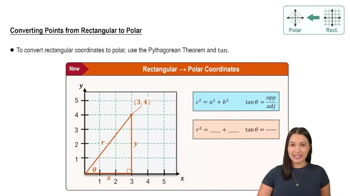
Convert Points from Rectangular to Polar