
교과서 질문
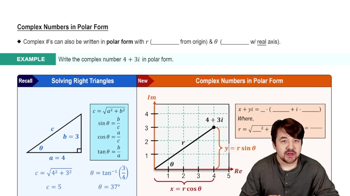
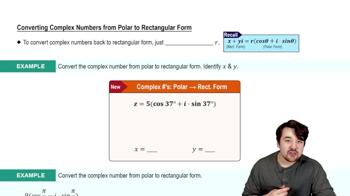
In Exercises 25–29, use DeMoivre's Theorem to find the indicated power of the complex number. Write answers in rectangular form. [2(cos 20° + i sin 20°)]³
579
views

 검증된 단계별 안내
 04:47
04:47
 03:58
03:58 5:32
5:32In Exercises 25–29, use DeMoivre's Theorem to find the indicated power of the complex number. Write answers in rectangular form. [2(cos 20° + i sin 20°)]³
In Exercises 27–32, select the representations that do not change the location of the given point. (7, 140°) (−7, 320°)
In Exercises 13–34, test for symmetry and then graph each polar equation. r = 4 sin 3θ
In Exercises 21–40, eliminate the parameter t. Then use the rectangular equation to sketch the plane curve represented by the given parametric equations. Use arrows to show the orientation of the curve corresponding to increasing values of t. (If an interval for t is not specified, assume that −∞ < t < ∞. _ x = √t, y = t − 1
In Exercises 25–29, use DeMoivre's Theorem to find the indicated power of the complex number. Write answers in rectangular form. [1/2 (cos π/14 + i sin π/14)]⁷
In Exercises 21–40, eliminate the parameter t. Then use the rectangular equation to sketch the plane curve represented by the given parametric equations. Use arrows to show the orientation of the curve corresponding to increasing values of t. (If an interval for t is not specified, assume that −∞ < t < ∞.
x = 2 sin t, y = 2 cos t; 0 ≤ t < 2π