In Exercises 21–40, eliminate the parameter t. Then use the rectangular equation to sketch the plane curve represented by the given parametric equations. Use arrows to show the orientation of the curve corresponding to increasing values of t. (If an interval for t is not specified, assume that −∞ < t < ∞. x = 2ᵗ, y = 2⁻ᵗ; t ≥ 0

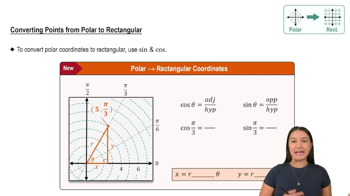
In Exercises 33–40, polar coordinates of a point are given. Find the rectangular coordinates of each point. (−4, π/2)
검증된 단계별 안내
비슷한 문제에 대한 검증된 영상 답변:
주요 개념
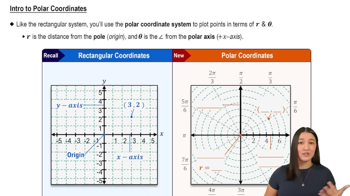
Polar Coordinates
Rectangular Coordinates
Conversion Formulas between Polar and Rectangular Coordinates
In Exercises 33–40, polar coordinates of a point are given. Find the rectangular coordinates of each point. (7.4, 2.5)
In Exercises 35–44, test for symmetry and then graph each polar equation. r = 1 / 1−cos θ
In Exercises 37–52, perform the indicated operations and write the result in standard form. ___ ___ √−64 − √−25
In Exercises 37–44, find the product of the complex numbers. Leave answers in polar form. z₁ = 6(cos 20° + i sin 20°) z₂ = 5(cos 50° + i sin 50°)
In Exercises 21–40, eliminate the parameter t. Then use the rectangular equation to sketch the plane curve represented by the given parametric equations. Use arrows to show the orientation of the curve corresponding to increasing values of t. (If an interval for t is not specified, assume that −∞ < t < ∞.
x = 5 sec t, y = 3 tan t
