Ch. 5 - Complex Numbers, Polar Coordinates and Parametric Equations
Blitzer - Trigonometry 3rd Edition
Blitzer3rd EditionTrigonometryISBN: 9780137316601당신이 사용하는 게 아니라요?교과서 변경
5장, 문제 39

In Exercises 33–40, polar coordinates of a point are given. Find the rectangular coordinates of each point. (7.4, 2.5)

검증된 단계별 안내
1
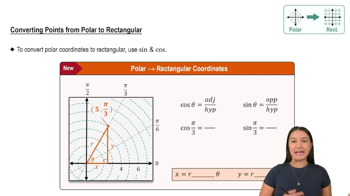
Recall the relationship between polar coordinates \((r, \theta)\) and rectangular coordinates \((x, y)\), where \(x = r \cos(\theta)\) and \(y = r \sin(\theta)\).
Identify the given polar coordinates: \(r = 7.4\) and \(\theta = 2.5\) radians.
Calculate the \(x\)-coordinate using the formula \(x = 7.4 \times \cos(2.5)\).
Calculate the \(y\)-coordinate using the formula \(y = 7.4 \times \sin(2.5)\).
Express the rectangular coordinates as the ordered pair \((x, y)\) using the values found in the previous steps.

비슷한 문제에 대한 검증된 영상 답변:

이 영상 해법은 위 문제에 도움이 된다고 튜터들이 추천한 것입니다.
영상 길이:
3m
도움이 되었나요?

주요 개념

질문에 올바르게 답하기 위해 반드시 이해해야 하는 핵심 개념들은 다음과 같습니다.

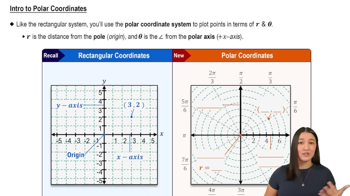
Polar Coordinates

Polar coordinates represent a point in the plane using a distance from the origin (radius r) and an angle (θ) measured from the positive x-axis. The given point (7.4, 2.5) means r = 7.4 and θ = 2.5 radians.
추천 영상:
05:32
Intro to Polar Coordinates

Conversion from Polar to Rectangular Coordinates

To convert polar coordinates (r, θ) to rectangular coordinates (x, y), use the formulas x = r cos(θ) and y = r sin(θ). This translates the point from a radius-angle format to Cartesian coordinates on the xy-plane.
추천 영상:
06:17
Convert Points from Polar to Rectangular

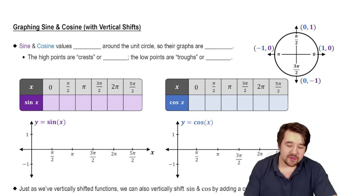
Trigonometric Functions (Sine and Cosine)

Sine and cosine functions relate an angle in a right triangle to the ratios of its sides. Cosine gives the ratio of the adjacent side to the hypotenuse, and sine gives the ratio of the opposite side to the hypotenuse, essential for coordinate conversion.
추천 영상:
5:53
Graph of Sine and Cosine Function