Ch. 5 - Complex Numbers, Polar Coordinates and Parametric Equations
Blitzer - Trigonometry 3rd Edition
Blitzer3rd EditionTrigonometryISBN: 9780137316601당신이 사용하는 게 아니라요?교과서 변경
5장, 문제 37

In Exercises 37–52, perform the indicated operations and write the result in standard form. ___ ___ √−64 − √−25

검증된 단계별 안내
1
Recognize that the square roots of negative numbers involve imaginary numbers. Recall that \(\sqrt{-a} = \sqrt{a} \times i\), where \(i\) is the imaginary unit with the property \(i^2 = -1\).
Rewrite each term using the imaginary unit: \(\sqrt{-64} = \sqrt{64} \times i\) and \(\sqrt{-25} = \sqrt{25} \times i\).
Calculate the square roots of the positive numbers: \(\sqrt{64} = 8\) and \(\sqrt{25} = 5\).
Substitute these values back into the expression: \(8i - 5i\).
Combine like terms (both are imaginary terms) to write the result in standard form \(a + bi\), where \(a\) and \(b\) are real numbers.

비슷한 문제에 대한 검증된 영상 답변:

이 영상 해법은 위 문제에 도움이 된다고 튜터들이 추천한 것입니다.
영상 길이:
2m
도움이 되었나요?

주요 개념

질문에 올바르게 답하기 위해 반드시 이해해야 하는 핵심 개념들은 다음과 같습니다.

Imaginary Numbers and the Imaginary Unit i

Imaginary numbers arise when taking the square root of negative numbers. The imaginary unit i is defined as √−1, allowing us to express roots of negative numbers as multiples of i, such as √−64 = 8i.
추천 영상:
2:20
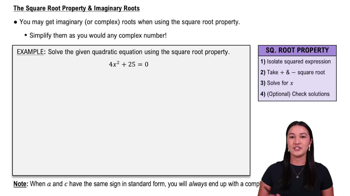
Imaginary Roots with the Square Root Property

Simplifying Square Roots of Negative Numbers

To simplify the square root of a negative number, separate it into the square root of the positive part and the imaginary unit i. For example, √−25 = √25 × √−1 = 5i, which helps in performing arithmetic operations.
추천 영상:
2:20
Imaginary Roots with the Square Root Property

Standard Form of Complex Numbers

The standard form of a complex number is a + bi, where a and b are real numbers. After performing operations with imaginary numbers, express the result in this form to clearly separate the real and imaginary parts.
추천 영상:
04:47
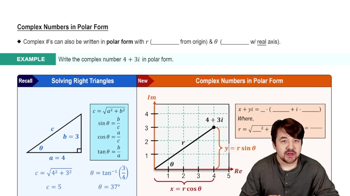
Complex Numbers In Polar Form