Find two different sets of parametric equations for y = x² + 6.
Ch. 5 - Complex Numbers, Polar Coordinates and Parametric Equations

5장, 문제 81
In Exercises 81–86, solve each equation in the complex number system. Express solutions in polar and rectangular form. x⁶ − 1 = 0
검증된 단계별 안내1
Recognize that the equation \(x^{6} - 1 = 0\) can be rewritten as \(x^{6} = 1\). This means we are looking for the sixth roots of unity in the complex plane.
Express the number 1 in polar form. Since 1 is on the positive real axis, its polar form is \(1 = 1 \left( \cos 0 + i \sin 0 \right)\), or equivalently \(1 = 1 \operatorname{cis} 0\) where \(\operatorname{cis} \theta = \cos \theta + i \sin \theta\).
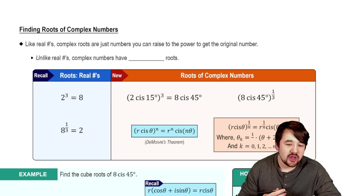
Use De Moivre's Theorem to find all sixth roots of unity. The general formula for the \(n\)th roots of a complex number \(r \operatorname{cis} \theta\) is \(r^{1/n} \operatorname{cis} \left( \frac{\theta + 2k\pi}{n} \right)\) for \(k = 0, 1, 2, ..., n-1\). Here, \(r=1\), \(\theta=0\), and \(n=6\).
Calculate each root by substituting \(k = 0, 1, 2, 3, 4, 5\) into the formula \(x_k = 1 \operatorname{cis} \left( \frac{2k\pi}{6} \right) = \cos \left( \frac{2k\pi}{6} \right) + i \sin \left( \frac{2k\pi}{6} \right)\) to get all six solutions in polar and rectangular form.
Write each solution explicitly in rectangular form as \(x_k = \cos \left( \frac{2k\pi}{6} \right) + i \sin \left( \frac{2k\pi}{6} \right)\) and in polar form as \(x_k = 1 \operatorname{cis} \left( \frac{2k\pi}{6} \right)\) for \(k = 0, 1, 2, 3, 4, 5\).

비슷한 문제에 대한 검증된 영상 답변:
이 영상 해법은 위 문제에 도움이 된다고 튜터들이 추천한 것입니다.
영상 길이:
10m도움이 되었나요?
주요 개념
질문에 올바르게 답하기 위해 반드시 이해해야 하는 핵심 개념들은 다음과 같습니다.
Complex Roots of Unity
The equation x⁶ − 1 = 0 represents the 6th roots of unity, which are complex numbers that satisfy x⁶ = 1. These roots are evenly spaced points on the unit circle in the complex plane, each corresponding to an angle of 2πk/6 for k = 0, 1, ..., 5.
추천 영상:
Complex Roots
Polar Form of Complex Numbers
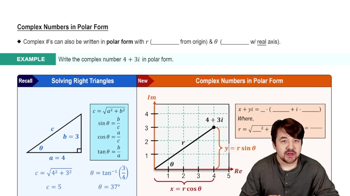
Polar form expresses a complex number as r(cos θ + i sin θ), where r is the magnitude and θ is the argument (angle). For roots of unity, r = 1, and θ corresponds to the angles dividing the circle evenly, making it easier to represent and multiply complex numbers.
추천 영상:
Complex Numbers In Polar Form
Conversion Between Polar and Rectangular Forms
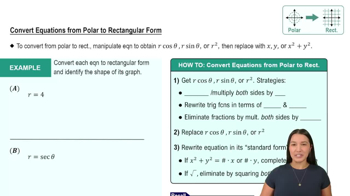
Rectangular form represents complex numbers as a + bi, where a and b are real numbers. To convert from polar to rectangular form, use a = r cos θ and b = r sin θ. This conversion is essential to express solutions in both requested forms.
추천 영상:
Convert Equations from Polar to Rectangular
관련 실천
교과서 질문
728
views
교과서 질문
In Exercises 81–82, find the rectangular coordinates of each pair of points. Then find the distance, in simplified radical form, between the points. (2, 2π/3) and (4, π/6)
817
views
교과서 질문
In Exercises 77–80, convert to polar form and then perform the indicated operations. Express answers in polar and rectangular form.
(1 + i√3)(1 − i)) / 2√3 − 2i
484
views
교과서 질문
In Exercises 81–86, solve each equation in the complex number system. Express solutions in polar and rectangular form.
x³ − (1 + i√3) = 0
838
views
교과서 질문
In Exercises 79–80, convert each polar equation to a rectangular equation. Then determine the graph's slope and y-intercept.
r sin (θ − π/4) = 2
788
views
교과서 질문
In Exercises 81–86, solve each equation in the complex number system. Express solutions in polar and rectangular form.
x⁴ + 16i = 0
840
views