In Exercises 81–86, solve each equation in the complex number system. Express solutions in polar and rectangular form. x⁶ − 1 = 0
Ch. 5 - Complex Numbers, Polar Coordinates and Parametric Equations

5장, 문제 83
In Exercises 81–86, solve each equation in the complex number system. Express solutions in polar and rectangular form.
x⁴ + 16i = 0
검증된 단계별 안내1
Rewrite the equation as \(x^4 = -16i\) to isolate the term with the variable.
Express the complex number \(-16i\) in polar form. Recall that any complex number \(z = a + bi\) can be written as \(r(\cos \theta + i \sin \theta)\), where \(r = \sqrt{a^2 + b^2}\) and \(\theta = \arctan(\frac{b}{a})\).
Calculate the magnitude \(r\) of \(-16i\) and find its argument \(\theta\). Note that \(-16i\) lies on the negative imaginary axis, so determine the correct angle accordingly.
Use De Moivre's Theorem to find the fourth roots of \(-16i\). The formula for the \(n\)th roots of a complex number in polar form \(r(\cos \theta + i \sin \theta)\) is given by:
\(x_k = r^{1/n} \left( \cos \left( \frac{\theta + 2\pi k}{n} \right) + i \sin \left( \frac{\theta + 2\pi k}{n} \right) \right)\),
where \(k = 0, 1, 2, ..., n-1\).
Calculate each root \(x_k\) for \(k = 0, 1, 2, 3\) in polar form, then convert each root to rectangular form using \(x = r \cos \theta\) and \(y = r \sin \theta\) to express the solutions as \(x + yi\).

비슷한 문제에 대한 검증된 영상 답변:
이 영상 해법은 위 문제에 도움이 된다고 튜터들이 추천한 것입니다.
영상 길이:
9m도움이 되었나요?
주요 개념
질문에 올바르게 답하기 위해 반드시 이해해야 하는 핵심 개념들은 다음과 같습니다.
Complex Numbers in Rectangular and Polar Form
Complex numbers can be expressed in rectangular form as a + bi, where a and b are real numbers, and in polar form as r(cos θ + i sin θ) or re^{iθ}, where r is the magnitude and θ is the argument. Converting between these forms is essential for solving equations involving complex numbers.
추천 영상:
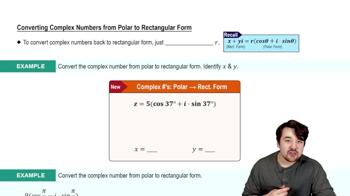
Converting Complex Numbers from Polar to Rectangular Form
De Moivre's Theorem
De Moivre's theorem states that for a complex number in polar form, (r(cos θ + i sin θ))^n = r^n (cos nθ + i sin nθ). This theorem is crucial for finding roots and powers of complex numbers, allowing the equation x⁴ + 16i = 0 to be solved by expressing terms in polar form and applying the theorem.
추천 영상:
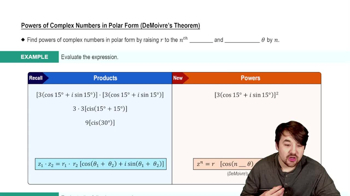
Powers Of Complex Numbers In Polar Form (DeMoivre's Theorem)
Solving Polynomial Equations in the Complex Plane
Solving polynomial equations like x⁴ + 16i = 0 involves finding all complex roots, which may be multiple and evenly spaced in the complex plane. Using polar form and De Moivre's theorem helps identify these roots by equating magnitudes and arguments, then converting solutions back to rectangular form.
추천 영상:
Solving Linear Equations
관련 실천
교과서 질문
754
views
교과서 질문
In calculus, it can be shown that e^(iθ) = cos θ + i sin θ. In Exercises 87–90, use this result to plot each complex number. e^(πi/4)
749
views
교과서 질문
In Exercises 81–82, find the rectangular coordinates of each pair of points. Then find the distance, in simplified radical form, between the points. (2, 2π/3) and (4, π/6)
817
views
교과서 질문
In Exercises 81–86, solve each equation in the complex number system. Express solutions in polar and rectangular form.
x³ − (1 + i√3) = 0
838
views
교과서 질문
In calculus, it can be shown that e^(iθ) = cos θ + i sin θ. In Exercises 87–90, use this result to plot each complex number. -e^-πi
694
views
교과서 질문
In Exercises 79–80, convert each polar equation to a rectangular equation. Then determine the graph's slope and y-intercept.
r sin (θ − π/4) = 2
788
views