Ch. 5 - Complex Numbers, Polar Coordinates and Parametric Equations
Blitzer - Trigonometry 3rd Edition
Blitzer3rd EditionTrigonometryISBN: 9780137316601당신이 사용하는 게 아니라요?교과서 변경
5장, 문제 85

In Exercises 81–86, solve each equation in the complex number system. Express solutions in polar and rectangular form.
x³ − (1 + i√3) = 0

검증된 단계별 안내
1
Rewrite the given equation as \(x^{3} = 1 + i\sqrt{3}\) to isolate \(x^{3}\) on one side.
Express the complex number on the right side, \(1 + i\sqrt{3}\), in polar form by finding its magnitude \(r\) and argument \(\theta\). Calculate the magnitude as \(r = \sqrt{1^{2} + (\sqrt{3})^{2}}\) and the argument as \(\theta = \tan^{-1}\left(\frac{\sqrt{3}}{1}\right)\).
Use De Moivre's Theorem to find the cube roots of the complex number. The general formula for the \(n\)th roots is \(x_k = r^{1/3} \left( \cos\left(\frac{\theta + 2k\pi}{3}\right) + i \sin\left(\frac{\theta + 2k\pi}{3}\right) \right)\) for \(k = 0, 1, 2\).
Calculate each root \(x_k\) in polar form by substituting \(k = 0, 1, 2\) into the formula to find the three distinct solutions.
Convert each polar form solution \(x_k = r^{1/3} (\cos \phi + i \sin \phi)\) into rectangular form using \(x_k = r^{1/3} \cos \phi + i r^{1/3} \sin \phi\) by evaluating the cosine and sine values.

비슷한 문제에 대한 검증된 영상 답변:

이 영상 해법은 위 문제에 도움이 된다고 튜터들이 추천한 것입니다.
영상 길이:
10m
도움이 되었나요?

주요 개념

질문에 올바르게 답하기 위해 반드시 이해해야 하는 핵심 개념들은 다음과 같습니다.

Complex Numbers in Rectangular and Polar Form

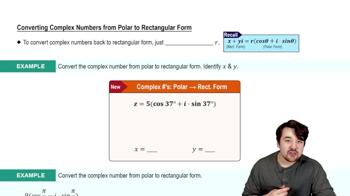
Complex numbers can be expressed in rectangular form as a + bi, where a is the real part and b is the imaginary part. Alternatively, they can be represented in polar form as r(cos θ + i sin θ), where r is the magnitude and θ is the argument (angle). Converting between these forms is essential for solving and expressing solutions clearly.
추천 영상:
03:58
Converting Complex Numbers from Polar to Rectangular Form

Roots of Complex Numbers and De Moivre's Theorem

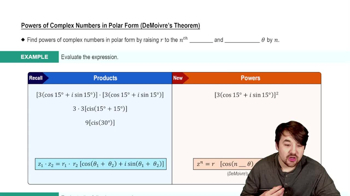
De Moivre's Theorem states that for a complex number in polar form, raising it to a power n involves raising the magnitude to n and multiplying the angle by n. Conversely, finding nth roots involves taking the nth root of the magnitude and dividing the angle by n, producing multiple solutions spaced evenly around the circle.
추천 영상:
03:41
Powers Of Complex Numbers In Polar Form (DeMoivre's Theorem)

Solving Polynomial Equations in the Complex Plane

Polynomial equations with complex coefficients can have multiple complex roots. To solve equations like x³ = c, express c in polar form, then find all cube roots by applying the nth root formula. Each root corresponds to a distinct solution in both rectangular and polar forms.
추천 영상:
7:48
Solving Linear Equations