Ch. 6 - Inverse Circular Functions and Trigonometric Equations
Lial - Trigonometry 12th Edition
Lial12th EditionTrigonometryISBN: 9780136552161당신이 사용하는 게 아니라요?교과서 변경
7장, 문제 45

Find the degree measure of θ if it exists. Do not use a calculator.
θ = csc⁻¹ (-2)

검증된 단계별 안내
1
Recall that the cosecant function is the reciprocal of the sine function, so \( \csc \theta = -2 \) means \( \sin \theta = \frac{1}{\csc \theta} = \frac{1}{-2} = -\frac{1}{2} \).
Understand that \( \csc^{-1}(-2) \) asks for the angle \( \theta \) whose cosecant is \(-2\), or equivalently, whose sine is \(-\frac{1}{2}\).
Identify the range of the inverse cosecant function, which is typically \( [-90^\circ, 90^\circ] \) excluding 0 degrees, or sometimes \( [ -90^\circ, 0^\circ ) \cup ( 0^\circ, 90^\circ ] \), depending on the convention. This means \( \theta \) will be in either the first or fourth quadrant.
Recall the reference angle where \( \sin \theta = \frac{1}{2} \) is \( 30^\circ \). Since the sine is negative, \( \theta \) must be in the fourth quadrant within the allowed range for \( \csc^{-1} \).
Conclude that \( \theta = -30^\circ \) because this angle has a sine of \( -\frac{1}{2} \) and lies within the principal range of the inverse cosecant function.

비슷한 문제에 대한 검증된 영상 답변:

이 영상 해법은 위 문제에 도움이 된다고 튜터들이 추천한 것입니다.
도움이 되었나요?

주요 개념

질문에 올바르게 답하기 위해 반드시 이해해야 하는 핵심 개념들은 다음과 같습니다.

Inverse Cosecant Function (csc⁻¹)

The inverse cosecant function, csc⁻¹(x), returns the angle whose cosecant is x. Since cosecant is the reciprocal of sine, csc⁻¹(x) = θ means sin(θ) = 1/x. Understanding this relationship helps convert the problem into finding an angle with a specific sine value.
추천 영상:
6:22
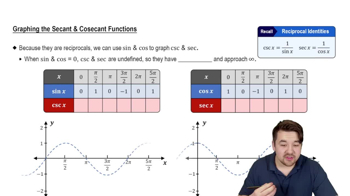
Graphs of Secant and Cosecant Functions

Domain and Range of csc⁻¹

The domain of csc⁻¹(x) excludes values between -1 and 1 because cosecant values are always ≤ -1 or ≥ 1. Its principal range is typically [-90°, 90°] excluding 0°, or [−π/2, π/2] in radians, where the function is defined and one-to-one. Recognizing this helps determine if a solution exists and its possible angle measure.
추천 영상:
4:22
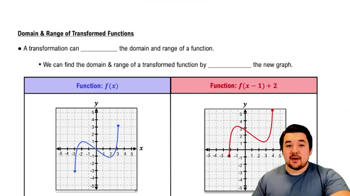
Domain and Range of Function Transformations

Evaluating Trigonometric Values Without a Calculator

To find exact angle measures without a calculator, use known special angles and their sine values, such as 30°, 45°, and 60°. Since sin(θ) = 1/(-2) = -1/2, identify the angle where sine equals -1/2 within the allowed range. This approach relies on memorized unit circle values and understanding of sine’s sign in different quadrants.
추천 영상:
7:28
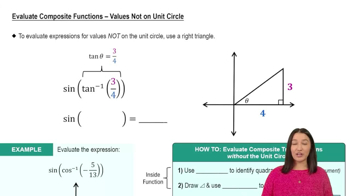
Evaluate Composite Functions - Values Not on Unit Circle