Ch. 6 - Inverse Circular Functions and Trigonometric Equations
Lial - Trigonometry 12th Edition
Lial12th EditionTrigonometryISBN: 9780136552161당신이 사용하는 게 아니라요?교과서 변경
7장, 문제 53

Use a calculator to approximate each value in decimal degrees.
θ = csc⁻¹ 1.9422833

검증된 단계별 안내
1
Recall that the cosecant function is the reciprocal of the sine function, so \( \csc \theta = x \) implies \( \sin \theta = \frac{1}{x} \).
Rewrite the given expression \( \theta = \csc^{-1} 1.9422833 \) as \( \theta = \sin^{-1} \left( \frac{1}{1.9422833} \right) \).
Calculate the reciprocal of 1.9422833 to find \( \sin \theta \), which is \( \frac{1}{1.9422833} \).
Use a calculator to find the inverse sine (arcsin) of the value obtained in the previous step, making sure your calculator is set to degree mode.
The result from the calculator will give you the approximate value of \( \theta \) in decimal degrees.

비슷한 문제에 대한 검증된 영상 답변:

이 영상 해법은 위 문제에 도움이 된다고 튜터들이 추천한 것입니다.
도움이 되었나요?

주요 개념

질문에 올바르게 답하기 위해 반드시 이해해야 하는 핵심 개념들은 다음과 같습니다.

Inverse Cosecant Function (csc⁻¹)

The inverse cosecant function, csc⁻¹(x), returns the angle whose cosecant is x. Since cosecant is the reciprocal of sine, csc⁻¹(x) = sin⁻¹(1/x). Understanding this relationship helps convert the problem into a more familiar inverse sine calculation.
추천 영상:
6:22
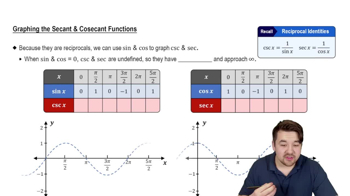
Graphs of Secant and Cosecant Functions

Reciprocal Trigonometric Functions

Cosecant is the reciprocal of sine, meaning csc(θ) = 1/sin(θ). This reciprocal relationship is essential for rewriting the inverse cosecant expression in terms of inverse sine, which is commonly available on calculators.
추천 영상:
6:04
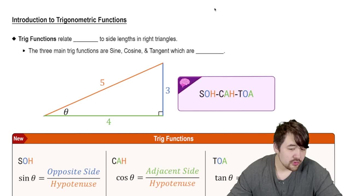
Introduction to Trigonometric Functions

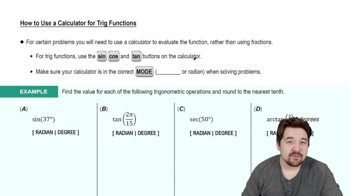
Using a Calculator to Find Angles in Degrees

Calculators typically provide inverse sine functions and allow switching between radians and degrees. To approximate θ in decimal degrees, convert csc⁻¹(x) to sin⁻¹(1/x) and ensure the calculator is set to degree mode before computing the angle.
추천 영상:
4:45
How to Use a Calculator for Trig Functions