Ch. 6 - Inverse Circular Functions and Trigonometric Equations
Lial - Trigonometry 12th Edition
Lial12th EditionTrigonometryISBN: 9780136552161당신이 사용하는 게 아니라요?교과서 변경
7장, 문제 51

Use a calculator to approximate each value in decimal degrees.
θ = arccos (-0.39876459)

검증된 단계별 안내
1
Understand that the problem asks for the angle \( \theta \) whose cosine value is \( -0.39876459 \). This is expressed as \( \theta = \arccos(-0.39876459) \).
Recall that the \( \arccos \) function (inverse cosine) returns an angle in the range \( 0^\circ \) to \( 180^\circ \) when working in degrees.
Use a calculator set to degree mode to find the approximate value of \( \theta \). Input the value \( -0.39876459 \) into the \( \arccos \) function.
The calculator will provide the angle \( \theta \) in decimal degrees, which is the angle whose cosine is \( -0.39876459 \).
Interpret the result as the principal value of the angle in degrees, which completes the approximation.

비슷한 문제에 대한 검증된 영상 답변:

이 영상 해법은 위 문제에 도움이 된다고 튜터들이 추천한 것입니다.
도움이 되었나요?

주요 개념

질문에 올바르게 답하기 위해 반드시 이해해야 하는 핵심 개념들은 다음과 같습니다.

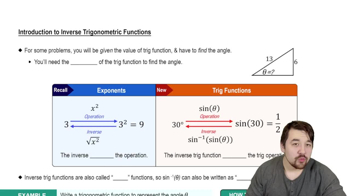
Inverse Trigonometric Functions

Inverse trigonometric functions, such as arccos, are used to find the angle that corresponds to a given trigonometric ratio. For arccos(x), it returns the angle whose cosine is x, typically within the range 0° to 180° for degrees.
추천 영상:
4:28
Introduction to Inverse Trig Functions

Domain and Range of arccos

The arccos function accepts input values between -1 and 1, inclusive, since cosine values lie within this range. Its output, or range, is limited to angles between 0° and 180°, ensuring a unique principal value for each input.
추천 영상:
4:22
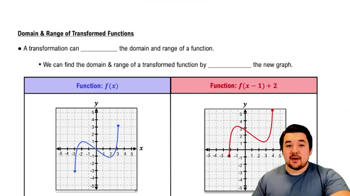
Domain and Range of Function Transformations

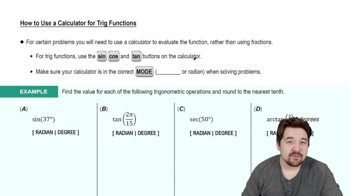
Using a Calculator for Trigonometric Approximations

Calculators can compute inverse trig functions to approximate angle measures in decimal degrees. It is important to set the calculator to degree mode and input the value correctly to obtain an accurate angle approximation.
추천 영상:
4:45
How to Use a Calculator for Trig Functions