Ch. 7 - Applications of Trigonometry and Vectors
8์žฅ, ๋ฌธ์ œ 48

Find the area of each triangle using the formula ๐“ = ยฝ bh, and then verify that the formula ๐“ = ยฝ ab sin C gives the same result.
<IMAGE>

๊ฒ€์ฆ๋œ ๋‹จ๊ณ„๋ณ„ ์•ˆ๋‚ด
1
Identify the base (b) and the height (h) of the triangle from the given image or information. The base is one side of the triangle, and the height is the perpendicular distance from the opposite vertex to this base.
Use the formula for the area of a triangle based on base and height: \(\mathcal{A} = \frac{1}{2} b h\). Substitute the values of base and height into this formula to express the area.
Next, identify two sides of the triangle, say \(a\) and \(b\), and the included angle \(C\) between them from the image or given data.
Use the formula for the area of a triangle using two sides and the included angle: \(\mathcal{A} = \frac{1}{2} a b \sin C\). Substitute the values of sides \(a\), \(b\), and angle \(C\) into this formula.
Compare the two expressions for the area obtained from the two formulas to verify that they give the same result, confirming the consistency of the area calculation methods.

๋น„์Šทํ•œ ๋ฌธ์ œ์— ๋Œ€ํ•œ ๊ฒ€์ฆ๋œ ์˜์ƒ ๋‹ต๋ณ€:

์ด ์˜์ƒ ํ•ด๋ฒ•์€ ์œ„ ๋ฌธ์ œ์— ๋„์›€์ด ๋œ๋‹ค๊ณ  ํŠœํ„ฐ๋“ค์ด ์ถ”์ฒœํ•œ ๊ฒƒ์ž…๋‹ˆ๋‹ค.
๋„์›€์ด ๋˜์—ˆ๋‚˜์š”?

์ฃผ์š” ๊ฐœ๋…

์งˆ๋ฌธ์— ์˜ฌ๋ฐ”๋ฅด๊ฒŒ ๋‹ตํ•˜๊ธฐ ์œ„ํ•ด ๋ฐ˜๋“œ์‹œ ์ดํ•ดํ•ด์•ผ ํ•˜๋Š” ํ•ต์‹ฌ ๊ฐœ๋…๋“ค์€ ๋‹ค์Œ๊ณผ ๊ฐ™์Šต๋‹ˆ๋‹ค.

Area of a Triangle Using Base and Height

The formula ๐“ = ยฝ bh calculates the area of a triangle by multiplying the base length (b) by the height (h) perpendicular to that base, then dividing by two. This method requires knowing the height, which is the perpendicular distance from the base to the opposite vertex.
์ถ”์ฒœ ์˜์ƒ:
๊ฐ€์ด๋“œ ์ฝ”์Šค
4:02
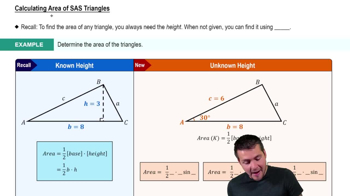
Calculating Area of SAS Triangles

Area of a Triangle Using Two Sides and Included Angle

The formula ๐“ = ยฝ ab sin C finds the area by using two sides (a and b) and the sine of the included angle (C) between them. This approach is useful when the height is not known but two sides and the included angle are given, leveraging trigonometric relationships.
์ถ”์ฒœ ์˜์ƒ:
๊ฐ€์ด๋“œ ์ฝ”์Šค
4:02
Calculating Area of SAS Triangles

Relationship Between the Two Area Formulas

Both formulas calculate the same area but use different known elements: one uses base and height, the other uses two sides and the included angle. Verifying equality involves understanding that height can be expressed as b sin C, linking the two methods through trigonometry.
์ถ”์ฒœ ์˜์ƒ:
๊ฐ€์ด๋“œ ์ฝ”์Šค
4:30
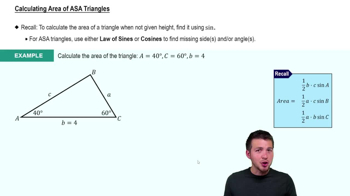
Calculating Area of ASA Triangles
๊ด€๋ จ ์‹ค์ฒœ
๊ต๊ณผ์„œ ์งˆ๋ฌธ

Starting at point A, a ship sails 18.5 km on a bearing of 189ยฐ, then turns and sails 47.8 km on a bearing of 317ยฐ. Find the distance of the ship from point A.

1036
views

๊ต๊ณผ์„œ ์งˆ๋ฌธ

A plane has an airspeed of 520 mph. The pilot wishes to fly on a bearing of 310ยฐ. A wind of 37 mph is blowing from a bearing of 212ยฐ. In what direction should the pilot fly, and what will be her ground speed?

774
views
๊ต๊ณผ์„œ ์งˆ๋ฌธ

Starting at point X, a ship sails 15.5 km on a bearing of 200ยฐ, then turns and sails 2.4 km on a bearing of 320ยฐ. Find the distance of the ship from point X.

853
views
๊ต๊ณผ์„œ ์งˆ๋ฌธ

One boat pulls a barge with a force of 100 newtons. Another boat pulls the barge at an angle of 45ยฐ to the first force, with a force of 200 newtons. Find the resultant force acting on the barge, to the nearest unit, and the angle between the resultant and the first boat, to the nearest tenth.

745
views
๊ต๊ณผ์„œ ์งˆ๋ฌธ

Write each vector in the form a i + b j.

โŒฉ2, 0โŒช

765
views
๊ต๊ณผ์„œ ์งˆ๋ฌธ

Solve each problem. See Examples 5 and 6.


Distance and Direction of a Motorboat A motorboat sets out in the direction N 80ยฐ 00โ€ฒ E. The speed of the boat in still water is 20.0 mph. If the current is flowing directly south, and the actual direction of the motorboat is due east, find the speed of the current and the actual speed of the motorboat.


<IMAGE>

849
views