Ch. 7 - Applications of Trigonometry and Vectors
Lial - Trigonometry 12th Edition
Lial12th EditionTrigonometryISBN: 9780136552161, 9780135440780, 9780136881117, 9780135440827, 9780135924891당신이 사용하는 게 아니라요?교과서 변경
8장, 문제 47

Starting at point A, a ship sails 18.5 km on a bearing of 189°, then turns and sails 47.8 km on a bearing of 317°. Find the distance of the ship from point A.

검증된 단계별 안내
1
Understand the problem: The ship starts at point A, sails 18.5 km on a bearing of 189°, then changes direction and sails 47.8 km on a bearing of 317°. We need to find the straight-line distance from the final position back to point A.
Convert the bearings into standard angles relative to the positive x-axis (east direction). Bearings are measured clockwise from north, so to convert a bearing \( \theta_b \) to an angle \( \theta \) from the positive x-axis, use \( \theta = 90° - \theta_b \). Adjust the angle to be between 0° and 360° if necessary.
Calculate the coordinates of the ship after each leg of the journey using trigonometry: For each leg, the change in x (east-west) is \( \Delta x = d \times \cos(\theta) \) and the change in y (north-south) is \( \Delta y = d \times \sin(\theta) \), where \( d \) is the distance sailed and \( \theta \) is the angle from the positive x-axis.
Sum the x and y components from both legs to find the final coordinates \( (x, y) \) of the ship relative to point A.
Use the distance formula to find the straight-line distance from point A to the final position: \[ \text{Distance} = \sqrt{x^2 + y^2} \].

비슷한 문제에 대한 검증된 영상 답변:

이 영상 해법은 위 문제에 도움이 된다고 튜터들이 추천한 것입니다.

주요 개념

질문에 올바르게 답하기 위해 반드시 이해해야 하는 핵심 개념들은 다음과 같습니다.

Bearings and Direction

Bearings are angles measured clockwise from the north direction to indicate direction. Understanding how to interpret bearings like 189° and 317° is essential for plotting the ship's path relative to the starting point.
추천 영상:
05:13
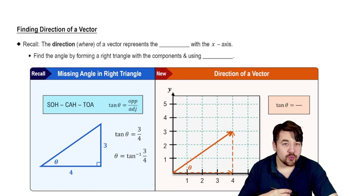
Finding Direction of a Vector

Vector Representation of Displacement

Each leg of the ship's journey can be represented as a vector with magnitude (distance sailed) and direction (bearing). Converting these vectors into components allows for the calculation of the resultant displacement from the starting point.
추천 영상:
03:48
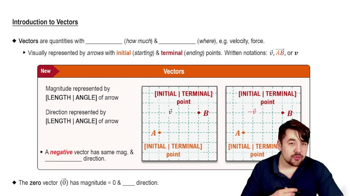
Introduction to Vectors

Distance Calculation Using the Pythagorean Theorem or Law of Cosines

After determining the resultant vector components or the angle between legs, the distance from the starting point can be found using the Pythagorean theorem for perpendicular components or the Law of Cosines for non-right triangles.
추천 영상:
가이드 코스
5:19
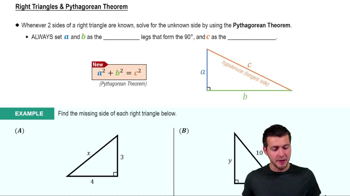
Solving Right Triangles with the Pythagorean Theorem