Starting at point A, a ship sails 18.5 km on a bearing of 189°, then turns and sails 47.8 km on a bearing of 317°. Find the distance of the ship from point A.
Ch. 7 - Applications of Trigonometry and Vectors
Lial12th EditionTrigonometryISBN: 9780136552161, 9780135440780, 9780136881117, 9780135440827, 9780135924891당신이 사용하는 게 아니라요?교과서 변경
8장, 문제 48
Starting at point X, a ship sails 15.5 km on a bearing of 200°, then turns and sails 2.4 km on a bearing of 320°. Find the distance of the ship from point X.
검증된 단계별 안내1
Understand the problem: The ship starts at point X, sails 15.5 km on a bearing of 200°, then sails 2.4 km on a bearing of 320°. We need to find the straight-line distance from the final position back to point X.
Convert the bearings into standard angles relative to the positive x-axis (East). Bearings are measured clockwise from North (0°). So, for a bearing \( \theta_b \), the angle from the positive x-axis is \( \theta = 90° - \theta_b \). Calculate the angles for both legs:
First leg angle: \( \theta_1 = 90° - 200° = -110° \) (which can be interpreted as 250° in standard position).
Second leg angle: \( \theta_2 = 90° - 320° = -230° \) (which can be interpreted as 130° in standard position).
Find the coordinates of the ship after each leg by converting polar coordinates to Cartesian coordinates using \( x = r \cos(\theta) \) and \( y = r \sin(\theta) \). Then, sum the vectors to find the final position relative to point X. Finally, use the distance formula \( d = \sqrt{(x_{final})^2 + (y_{final})^2} \) to find the distance from point X.

비슷한 문제에 대한 검증된 영상 답변:
이 영상 해법은 위 문제에 도움이 된다고 튜터들이 추천한 것입니다.
주요 개념
질문에 올바르게 답하기 위해 반드시 이해해야 하는 핵심 개념들은 다음과 같습니다.
Bearings and Direction
Bearings are angles measured clockwise from the north direction to indicate direction. A bearing of 200° means the ship is sailing 20° west of due south, while 320° means 40° west of due north. Understanding bearings helps translate directional information into angles for calculations.
추천 영상:
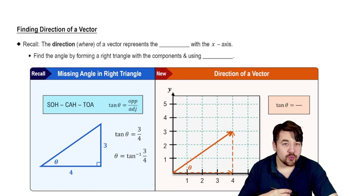
Finding Direction of a Vector
Vector Representation of Displacement
Each leg of the ship's journey can be represented as a vector with magnitude (distance sailed) and direction (bearing). Converting these vectors into components along the north-south and east-west axes allows for the calculation of the resultant displacement from the starting point.
추천 영상:
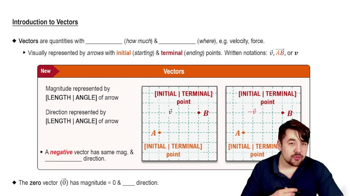
Introduction to Vectors
Distance Calculation Using the Pythagorean Theorem
After finding the resultant vector components, the distance from the starting point is the magnitude of this vector. The Pythagorean theorem is used to calculate this distance by taking the square root of the sum of the squares of the north-south and east-west components.
추천 영상:
가이드 코스
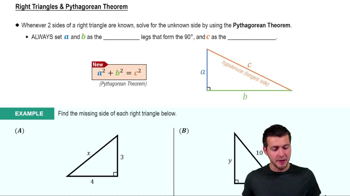
Solving Right Triangles with the Pythagorean Theorem
관련 실천
교과서 질문
1036
views
교과서 질문
A plane has an airspeed of 520 mph. The pilot wishes to fly on a bearing of 310°. A wind of 37 mph is blowing from a bearing of 212°. In what direction should the pilot fly, and what will be her ground speed?
774
views
교과서 질문
Find the area of each triangle using the formula 𝓐 = ½ bh, and then verify that the formula 𝓐 = ½ ab sin C gives the same result.
<IMAGE>
1174
views
교과서 질문
One boat pulls a barge with a force of 100 newtons. Another boat pulls the barge at an angle of 45° to the first force, with a force of 200 newtons. Find the resultant force acting on the barge, to the nearest unit, and the angle between the resultant and the first boat, to the nearest tenth.
745
views
교과서 질문
Write each vector in the form a i + b j.
〈2, 0〉
765
views
교과서 질문
Write each vector in the form a i + b j.
〈6, -3〉
857
views