Skip to main content
Macroeconomics
My Course
Learn
Exam Prep
AI Tutor
Study Guides
Flashcards
Explore
Try the app
My Course
Learn
Exam Prep
AI Tutor
Study Guides
Flashcards
Explore
Try the app
Back
AE Model and the Multiplier definitions
You can tap to flip the card.
Multiplier Effect
You can tap to flip the card.
👆
Multiplier Effect
Describes how an initial increase in spending leads to a proportionally larger rise in GDP through repeated rounds of income and consumption.
Track progress
Control buttons has been changed to "navigation" mode.
1/14
Related flashcards
Related practice
Recommended videos
AE Model and the Multiplier quiz
AE Model and the Multiplier
15 Terms
AE Model and the Multiplier
15. Deriving the Aggregate Expenditures Model
10 problems
Topic
AE Model: Algebraic Approach
15. Deriving the Aggregate Expenditures Model
10 problems
Topic
16. Deriving the Aggregate Expenditures Model
7 topics
13 problems
Chapter
Guided course
11:37
AE Model and the Multiplier
2149
views
32
rank
Terms in this set (14)
Hide definitions
Multiplier Effect
Describes how an initial increase in spending leads to a proportionally larger rise in GDP through repeated rounds of income and consumption.
Aggregate Expenditures
Total planned spending in an economy, including consumption, investment, government purchases, and net exports.
Consumption Function
Represents the relationship between consumption and disposable income, including a base level and a portion tied to income.
Marginal Propensity to Consume
Fraction of additional income that households spend on consumption, determining the slope of the aggregate expenditures line.
Equilibrium GDP
Level of output where total spending equals total production, found where the aggregate expenditures line crosses the 45-degree line.
Investment Spending
Expenditures on capital goods that add to productive capacity, treated as a constant in the model unless changed.
Government Purchases
Spending by the public sector on goods and services, considered a component of aggregate expenditures.
Net Exports
Difference between a country's exports and imports, included as a constant in aggregate expenditures.
Slope of Aggregate Expenditures Line
Determined by the marginal propensity to consume, it influences how much GDP changes in response to spending shifts.
Initial Spending Boost
The original increase in investment, government purchases, or net exports that triggers the multiplier process.
45-Degree Line
Graphical tool where every point shows spending equals production, used to find equilibrium GDP.
Base Consumption
Minimum level of consumption that occurs even when income is zero, forming part of the consumption function.
Aggregate Expenditures Curve
Graph showing the relationship between total planned spending and GDP, shifting with changes in spending components.
Policy-Making
Process where authorities use tools like government spending to influence GDP, especially during economic downturns.
 BackBack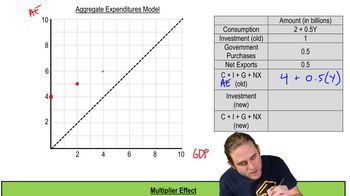
 11:37
11:37