In which case can we be sure that aggregate demand shifts to the left overall?
Aggregate demand shifts left overall when there is a decrease in one or more of its components—consumption, investment, government purchases, or net exports—such as during a decline in consumer confidence, reduced investment spending, lower government expenditures, or a fall in net exports.
Which of the following events would most likely reduce aggregate demand?
A decrease in consumer spending, a fall in investment due to higher interest rates, a reduction in government purchases, or a decline in net exports would most likely reduce aggregate demand.
Which of the following is included in the aggregate demand for goods and services?
Aggregate demand includes consumption, investment, government purchases, and net exports.
Which of the following would cause a decrease in aggregate demand?
A decrease in aggregate demand can be caused by lower consumer confidence, higher interest rates reducing investment, decreased government spending, or a reduction in net exports.
If aggregate demand increases and aggregate supply decreases, what happens to the price level?
If aggregate demand increases and aggregate supply decreases, the price level rises.
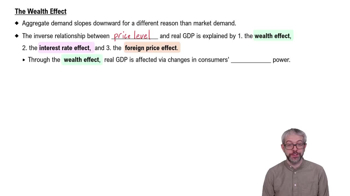
A price level increase causing a movement along the aggregate demand curve can be explained by which effect?
A movement along the aggregate demand curve due to a price level increase can be explained by the wealth effect, the interest rate effect, and the exchange rate effect, which all reduce the quantity of real GDP demanded as the price level rises.
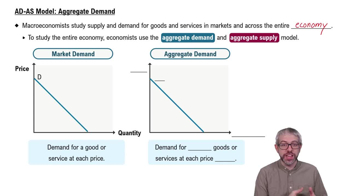
How does the aggregate demand curve differ from a single market demand curve in terms of substitution effects?
Unlike a single market demand curve, the aggregate demand curve does not include a substitution effect because it represents demand for all goods and services in the economy, so substituting one good for another does not change overall demand.
What happens to the real value of money when the price level decreases in the economy?
When the price level decreases, the real value of money increases, allowing consumers to purchase more goods and services with the same amount of money.
Why does investment spending increase when price levels fall according to the interest rate effect?
Lower price levels allow households to save more, increasing the supply of savings and causing interest rates to fall, which encourages firms to invest more.
How do falling U.S. price levels affect net exports in the aggregate demand model?
Falling U.S. price levels make American goods cheaper for foreign buyers, increasing exports and thus raising net exports as a component of aggregate demand.