Skip to main content
Macroeconomics
My Course
Learn
Exam Prep
AI Tutor
Study Guides
Flashcards
Explore
Try the app
My Course
Learn
Exam Prep
AI Tutor
Study Guides
Flashcards
Explore
Try the app
Back
Circular Flow Diagram definitions
You can tap to flip the card.
Circular Flow Diagram
You can tap to flip the card.
👆
Circular Flow Diagram
A visual model showing how money, resources, goods, and services move between households and firms in an economy.
Track progress
Control buttons has been changed to "navigation" mode.
1/14
Related flashcards
Related practice
Recommended videos
Circular Flow Diagram quiz
Circular Flow Diagram
15 Terms
Circular Flow Diagram
1. Introduction to Macroeconomics
10 problems
Topic
Graphing Review
1. Introduction to Macroeconomics
5 problems
Topic
1. Introduction to Macroeconomics - Part 1 of 2
8 topics
14 problems
Chapter
1. Introduction to Macroeconomics - Part 2 of 2
1 topic
3 problems
Chapter
Guided course
01:32
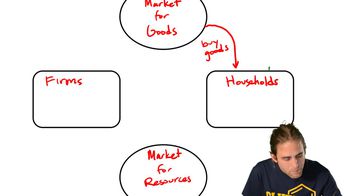
Households and Firms
7015
views
105
rank
Guided course
04:20
The Circular Flow Diagram
6438
views
169
rank
Terms in this set (14)
Hide definitions
Circular Flow Diagram
A visual model showing how money, resources, goods, and services move between households and firms in an economy.
Households
Economic agents who own resources and receive income by selling them, while spending money to purchase goods and services.
Firms
Organizations that transform resources into goods and services, earning revenue by selling these outputs.
Goods and Services
Outputs produced by firms and purchased by households to satisfy wants and needs.
Factors of Production
Resources such as labor and land, owned by households and used by firms to create goods and services.
Market for Goods and Services
Arena where households purchase and firms sell outputs, facilitating the exchange of finished products.
Market for Resources
Setting where households provide resources and firms acquire inputs needed for production.
Revenue
Money received by firms from selling goods and services to households in the product market.
Income
Earnings households receive from selling resources, including wages and rent, in the resource market.
Resources
Inputs like labor and land, owned by households and essential for firms’ production processes.
Interdependence
Mutual reliance between households and firms, as each depends on the other for resources, goods, and money.
Money Flow
Movement of currency in the economy, with households spending and firms paying for resources.
Product Market
Another term for the market where goods and services are exchanged between households and firms.
Resource Market
Another term for the market where factors of production are traded between households and firms.
 BackBack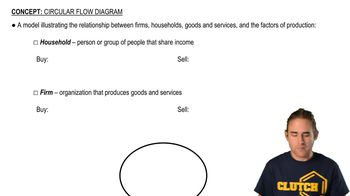
 01:32
01:32