Skip to main content
Macroeconomics
My Course
Learn
Exam Prep
AI Tutor
Study Guides
Flashcards
Explore
Try the app
My Course
Learn
Exam Prep
AI Tutor
Study Guides
Flashcards
Explore
Try the app
Back
Condorcet Voting Paradox definitions
You can tap to flip the card.
Condorcet Voting Paradox
You can tap to flip the card.
👆
Condorcet Voting Paradox
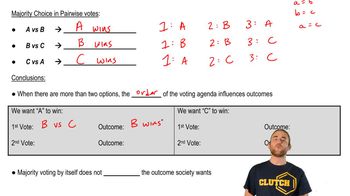
A situation where majority rule leads to cyclical group preferences, making collective choices inconsistent and unpredictable.
Track progress
Control buttons has been changed to "navigation" mode.
1/14
Related flashcards
Recommended videos
Condorcet Voting Paradox quiz
Condorcet Voting Paradox
15 Terms
Guided course
03:39
Condorcet Voting Paradox
5
views
Guided course
02:33
Order of the Vote
3
views
Terms in this set (14)
Hide definitions
Condorcet Voting Paradox
A situation where majority rule leads to cyclical group preferences, making collective choices inconsistent and unpredictable.
Majority Voting
A decision process where the option with more than half the votes wins, but may not always reflect consistent group preferences.
Transitivity
A logical property where if one option is preferred to a second, and the second to a third, the first should be preferred to the third.
Cyclical Preferences
A pattern where group choices loop back on themselves, such as preferring A over B, B over C, but C over A.
Voting Agenda
The sequence or order in which options are presented for voting, which can influence the final outcome.
Policy Manipulation
The strategic arrangement of voting order to ensure a desired option wins, regardless of true group preferences.
Aggregate Demand Management
The process of influencing overall economic demand, where group decision-making can be affected by voting paradoxes.
Group Preferences
The collective ranking or ordering of choices by different segments within a voting population.
Inconsistent Outcomes
Results where the collective choice does not follow logical order, often due to cyclical majority preferences.
Policyholders
Individuals or groups with the authority to set agendas and influence which options are considered in a vote.
Societal Preferences
The overall desires or priorities of a community, which may not be accurately reflected by simple majority voting.
Strategic Elimination
The removal of certain options early in the voting process to shape the final outcome in favor of a preferred choice.
Political Economy
The study of how political forces and economic systems interact, especially in collective decision-making.
Pairwise Comparison
A method where options are evaluated two at a time, revealing possible cycles in group preferences.
 BackBack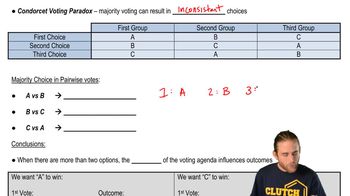
 03:39
03:39