Skip to main content
Macroeconomics
My Course
Learn
Exam Prep
AI Tutor
Study Guides
Flashcards
Explore
Try the app
My Course
Learn
Exam Prep
AI Tutor
Study Guides
Flashcards
Explore
Try the app
Back
Condorcet Voting Paradox quiz
You can tap to flip the card.
What is the Condorcet Voting Paradox?
You can tap to flip the card.
👆
What is the Condorcet Voting Paradox?
It is a situation where majority voting leads to inconsistent or cyclical outcomes, violating transitivity.
Track progress
Control buttons has been changed to "navigation" mode.
1/15
Related flashcards
Recommended videos
Condorcet Voting Paradox definitions
Condorcet Voting Paradox
14 Terms
Guided course
03:39
Condorcet Voting Paradox
5
views
Guided course
02:33
Order of the Vote
3
views
Terms in this set (15)
Hide definitions
What is the Condorcet Voting Paradox?
It is a situation where majority voting leads to inconsistent or cyclical outcomes, violating transitivity.
How does the Condorcet Paradox violate transitivity?
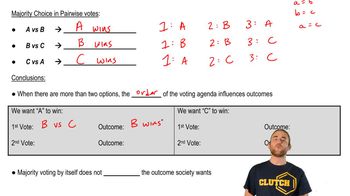
It shows that even if A beats B and B beats C, C can still beat A, breaking the expected transitive relationship.
What does majority voting mean in the context of the Condorcet Paradox?
Majority voting means the option with the most votes wins, but this can lead to cycles where no clear winner emerges.
How many groups and choices are used in the classic Condorcet Paradox example?
There are three groups and three choices in the classic example.
What is the outcome when A is voted against B in the example?
A wins the vote against B.
Who wins when B is voted against C in the example?
B wins the vote against C.
What happens when C is voted against A in the example?
C wins the vote against A.
Why does the order of the voting agenda matter in the Condorcet Paradox?
The order determines which options are eliminated first, allowing the outcome to be manipulated.
How can a policymaker ensure that option A wins using the voting agenda?
They can arrange for B and C to be voted first, eliminating C, then have A face B, where A wins.
What strategy should be used to make C win in the voting process?
Eliminate B first by having A vs. B, then have C face A, where C wins.
What does the Condorcet Paradox reveal about majority voting?
It reveals that majority voting can be manipulated and may not reflect true societal preferences.
Why might majority voting not produce the outcome society wants?
Because the process can be manipulated by setting the agenda, leading to outcomes that don't match overall preferences.
What is a key lesson from the Condorcet Paradox for political economy?
That the structure and order of voting can significantly affect policy outcomes.
How does the Condorcet Paradox relate to aggregate demand management?
It shows that collective decision-making in economic policy can be inconsistent or manipulated, affecting aggregate outcomes.
What is the main implication of the Condorcet Paradox for democratic decision-making?
That majority rule alone may not always yield consistent or fair results, highlighting the need for careful agenda design.
 BackBack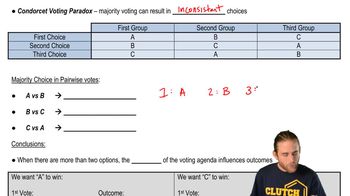
 03:39
03:39