Skip to main content
Macroeconomics
My Course
Learn
Exam Prep
AI Tutor
Study Guides
Flashcards
Explore
Try the app
My Course
Learn
Exam Prep
AI Tutor
Study Guides
Flashcards
Explore
Try the app
Back
Demand-Pull and Cost-Push Inflation definitions
You can tap to flip the card.
Demand-Pull Inflation
You can tap to flip the card.
👆
Demand-Pull Inflation
A rise in prices caused by increased spending when supply cannot expand, resulting in higher prices without increased output.
Track progress
Control buttons has been changed to "navigation" mode.
1/15
Related flashcards
Related practice
Recommended videos
Demand-Pull and Cost-Push Inflation quiz #1
Demand-Pull and Cost-Push Inflation
16 Terms
Demand-Pull and Cost-Push Inflation
11. Unemployment and Inflation
10 problems
Topic
Costs of Inflation: Shoe-leather Costs and Menu Costs
11. Unemployment and Inflation
10 problems
Topic
12. Unemployment and Inflation
8 topics
11 problems
Chapter
Guided course
03:53
Demand-Pull Inflation
1805
views
23
rank
Guided course
02:22
Cost-Push Inflation
1347
views
26
rank
Terms in this set (15)
Hide definitions
Demand-Pull Inflation
A rise in prices caused by increased spending when supply cannot expand, resulting in higher prices without increased output.
Cost-Push Inflation
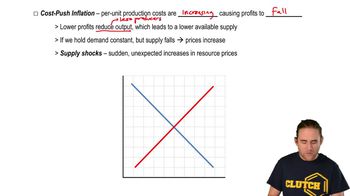
A rise in prices triggered by higher production expenses, leading to reduced profits, lower output, and fewer producers.
Equilibrium Price
The market price where quantity demanded equals quantity supplied, shifting upward during inflationary pressures.
Supply Shock
An unexpected event causing a sudden decrease in supply, often due to increased input costs, resulting in higher prices.
Quantity Supplied
The amount of goods producers are willing to sell at a given price, which may remain fixed during demand-pull inflation.
Quantity Demanded
The amount of goods consumers are willing to buy at a given price, which increases during demand-pull inflation.
Production Costs
Expenses incurred by firms to create goods, which, when rising, can reduce profits and trigger cost-push inflation.
Profit
The financial gain for firms after covering costs, which declines when production costs rise, possibly causing firms to exit the market.
Output
The total quantity of goods produced, which may decrease when firms face higher costs and lower profits.
Market Graph
A visual representation of supply and demand curves, used to illustrate shifts leading to inflation.
Price Level
The average of current prices across the entire economy, which rises during both demand-pull and cost-push inflation.
Supply Curve
A graphical line showing the relationship between price and quantity supplied, shifting left during cost-push inflation.
Demand Curve
A graphical line showing the relationship between price and quantity demanded, shifting right during demand-pull inflation.
Inflation
A general increase in prices across the economy, resulting from either heightened demand or increased production costs.
Raw Materials
Basic inputs used in production, whose price increases can trigger supply shocks and cost-push inflation.
 BackBack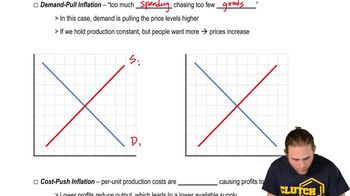
 03:53
03:53