Back

Deriving Aggregate Demand from the Aggregate Expenditure Model quiz

Control buttons has been changed to "navigation" mode.
1/15
  • What components make up aggregate expenditures in the Aggregate Expenditure Model?

    Aggregate expenditures are made up of consumption, investment, government spending, and net exports.
  • How does a higher price level affect aggregate expenditures?

    A higher price level decreases aggregate expenditures because consumption, investment, and net exports all fall.
  • What happens to GDP when the price level in the economy rises?

    When the price level rises, GDP decreases due to lower aggregate expenditures.
  • On the aggregate demand graph, what are the axes labeled?

    The vertical axis is labeled 'price level' and the horizontal axis is labeled 'GDP.'
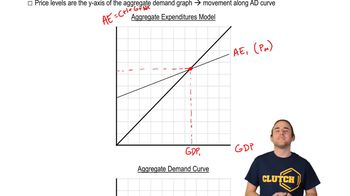
  • How is the aggregate demand curve derived from the aggregate expenditure model?

    By plotting equilibrium GDP at different price levels from the aggregate expenditure model, you can derive the aggregate demand curve.
  • What effect do lower prices have on consumption, investment, and net exports?

    Lower prices increase consumption, investment, and net exports, leading to higher aggregate expenditures.
  • What is the relationship between price level and aggregate expenditures?

    As the price level increases, aggregate expenditures decrease, and as the price level decreases, aggregate expenditures increase.
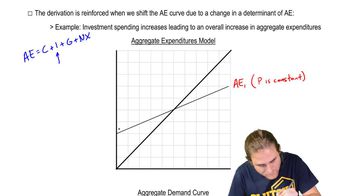
  • What happens to the aggregate demand curve when investment spending increases while the price level is constant?

    The aggregate demand curve shifts to the right, indicating more GDP is demanded at the same price level.
  • What is the equilibrium in the aggregate expenditure model?

    Equilibrium occurs where aggregate expenditures equal GDP, meaning spending matches production.
  • Which effects explain why higher prices reduce consumption, investment, and net exports?

    The wealth effect, interest rate effect, and exchange rate effect explain these reductions.
  • If aggregate expenditures increase at a constant price level, what happens to equilibrium GDP?

    Equilibrium GDP increases because higher aggregate expenditures mean more production is needed.
  • What does a rightward shift of the aggregate demand curve represent?

    It represents an increase in GDP demanded at each price level, often due to higher investment or other spending.
  • How does the aggregate expenditure model treat price level compared to the aggregate demand model?

    The aggregate expenditure model does not show price level directly, while the aggregate demand model includes price level as a key variable.
  • What happens to the aggregate expenditures curve if there is a boost in investment spending?

    The aggregate expenditures curve shifts upward, indicating higher spending at each level of GDP.
  • Why does the aggregate demand curve slope downward?

    Because higher prices lead to lower aggregate expenditures and GDP, while lower prices increase them, resulting in a downward-sloping curve.